Showing posts with label Taiwan. Show all posts

Tuesday, June 03, 2008

A return to books, and thoughts on translations

I've been reading a lot lately, following the completion of my last class and a change of jobs. After being hired as managing editor of The Industry Standard at the beginning of the year, I decided I needed to brush up on the history of Silicon Valley and the first Web bubble, so I tackled The New New Thing, The Nudist On The Late Shift, and a history of The Industry Standard itself, Starving To Death on $200 Million. I also read The Search, by Industry Standard and Wired founder John Battelle, and the first half of a dry tome on UIs and GUIs entitled The Human Interface.

I read fiction, as well. Since I was a teenager I have been a fan of fantasy and science fiction, and re-read The Hobbit as well as a newer book by an old favorite -- The Knight, by Gene Wolfe. Historical fiction is another genre that I love to explore, and one that I sorely missed when I was deep into my thesis and had no time to read for pleasure. The Piano Tuner has been sitting on my shelf for at least two years, and I was pleased to finally pull it down and finish it in a few days. Last month when we were on vacation, I finished Thomas Harris' Imperium, which is a depiction of several episodes in the life of Cicero. It was interesting, yet disappointing. I had greatly enjoyed Harris' earlier book about ancient Rome, Pompeii, and loved watching the first season of Rome on DVD with my wife, but Imperium came across as too disjointed, and too focused on Cicero's Machiavellian conspiracies in the Late Republic. This was perhaps a result of Harris' desire to remain true to the historical record as it relates to Cicero's life. Unfortunately, many of the extant primary sources consist of Cicero's political and legal treatises -- hardly ideal fodder for a gripping piece of historical fiction.

There are two other books that I have also been reading at a far slower pace. Both relate to Chinese history. They are Anthology of Chinese Literature: From Early Times to the Fourteenth Century, edited by Cyril Birch, and Return to Dragon Mountain: Memories of a Late Ming Man, by Jonathan Spence.

These books aren't meant to be rushed, especially the anthology. The appeal of the two books ties into my studies here -- much of my coursework centered on ancient and modern Chinese history. Both of them contain beautiful English translations of ancient texts written in classical Chinese, and I have to appreciate the skill involved in bringing them to life. Classical Chinese carries a special set of challenges in terms of translation, that goes beyond simply knowing Chinese characters or reading modern prose. The following is an excerpt from one of my last school papers, written for Matthew Battles' history of publishing course, entitled "Written Chinese: An Elitist Script, or a Language of the Masses?" In it, I explain the nature of classical Chinese, and some of the difficulties related to understanding it:
The Zhou dynasty (1122 – 256 B.C.E.) saw the rise of several important Chinese religious and philosophical movements, including Confucianism, Daoism, and Legalism. These sophisticated concepts were recorded in a series of important texts using a spare writing style called wenyan wen (lit. “literary language,” or “patterned words”). In English, it is known as “classical Chinese,” in reference to the five Confucian classics. Owing to a lack of audio recordings or historical descriptions of common speech, it is uncertain how closely the vernacular and written matched during the Zhou dynasty, but by the Han dynasty (206 B.C.E. – 220 A.D.) spoken Chinese (baihua wen, or “unadorned speech”) had evolved to a considerably different state from written Chinese.

For this reason, classical Chinese was (and still is) difficult to read. While spoken Chinese contains numerous words made up of two or more syllables, most classical Chinese consisted of monosyllables, or single characters. Sparse passages tended to suggest meaning, as opposed to clearly (or precisely) describing it.
My source for this information was Richard J. Smith's China’s Cultural Heritage: The Qing Dynasty, 1644-1912, 2nd ed. (Boulder, CO: Westview Press, 1983). On page 105 was a very interesting comparison of a famous passage from the philosopher Mencius, written in both vernacular and classical Chinese. The vernacular version was 38 characters, compared to just 24 in the original classical text. My wife -- a native Chinese speaker who grew up with traditional characters and has been exposed to classical Chinese through her own education in Taiwan -- understood all of the characters in the original, but was unable to translate the passage itself when I showed it to her. When I showed her the passage written out in vernacular Chinese, "Ah!" -- she got it right away.

So, when I read the beautiful translations of essayist Zhang Dai's (张岱) autobiographical accounts in Spence's book, and especially the poetic renderings by Arthur Waley and Ezra Pound in the anthology, I not only had to appreciate their skills as translators, but also their talents as writers.

They may have even taken poetic license a little too far in some cases. Consider this poem by the Tang's Han Yu (韓愈), translated by A.C. Graham, and appearing on page 262 of the anthology:
The Withered Tree

Leaf and twig are gone from the old tree,
Winds and frosts can harm it no more.
Its hollow belly has room for a man,
Circling ants quest under its peeling bark.
Its single lodger, the toadstool which lives for a morning;
The birds no longer visit in the evening.
But its wood can still spark tinder.
It does not care yet to be only the void at its heart.
(There is a footnote at the end of the last line says "The phrase equates the hollow hear of the tree and the Void Mind of Buddhism, emptied of desire and illusion")

This is a stunning poem in English, but I have to wonder about the challenges of making an appealing translation while remaining true to the original Chinese literary devices and references. In my years of working as a journalist in Taiwan (often with translators, editors, and other native Mandarin and Taiwanese speakers) I found that it was very difficult to take a Chinese phrase that includes complex emotions, concepts, or artistic expressions, and turn it into natural-sounding English that conveyed an accurate sense of the original. Incorporating literary flair involved an extra dimension of complexity.

The footnotes and other explanations by Spence, Birch, and the others are very helpful in terms of putting these works in context. It would have been helpful to include some of the original Chinese, but I understand the technical and economic reasons for not doing so. While I can't read classical Chinese, I do know a few hundred characters, and it's fun to look up others in the dictionary or ask my wife about them.

(Below: Classical Chinese in cursive script by Wang Duo (王铎), who grew up in the late Ming era and painted this sample in the early Qing. From the University of Maine website, which was sourced from the Shanghai Museum)
Source: Shanghai Museum and University of Maine website June 4 2008

Sunday, December 30, 2007

Generation G in Taiwan: Age gaps in Internet usage and blogging

On The Digital Media Machine blog, I recently discussed Generation G -- the under-40s who belong to the video game generation. I wrote:
Most people in this demographic grew up with games, and many of them still play now. They are familiar with gaming conventions relating to movement, exploration, cooperation, competition, and communication. Additionally, interaction with video games from an early age has created a foundation of familiarity and interest in computing technologies.
While I noted that more than 80 million people in the United States belong to this demographic, I did not get into the international dimension. According to the U.S. Census Bureau, there were nearly 4.5 billion people under the age of 40 as of mid-2007. Obviously, many of those in developing countries may never have seen a video game console or touched a computer, but in other countries parts of Europe and Asia, video games, computers, and the Internet are a way of life for people in this age group.

United Daily News articleThe ESWN blog found a report that supports the Generation G hypothesis in Taiwan. The United Daily News (lian he bao, 聯合報) reported the results of a telephone survey of 15,007 people from all over Taiwan that polled them on their 'Net habits, and broke down the results by age. The inset graphic is from the United Daily News website, and shows the data. Not surprisingly, almost 100% of the youngest bracket (aged 12 to 20) were Internet users. Most of the 21-30 and 31-40 groups were also online. But there was a steep dropoff from the 30-somethings to the 40-somethings, and just over one in five of the over-50s were online:
Age 12-20: 99.8%
Age 21-30: 94.4%
Age 31-40: 84.2%
Age 41-50: 58.6%
Age 51+: 21.9%
The survey also asked about blogging, and I was quite surprised to see how active Taiwan's teenagers were in this respect: Nearly half of the 12-20 year olds said they blog, and about 30% of 20-somethings do the same. 30-somethings in Taiwan are far less likely to blog, with just 12.5% saying that they maintain one. This matches with my own experience -- most of my Taiwanese friends are in their 30s and 40s, and I only know one who has a blog.

Monday, November 05, 2007

Undoing simplified characters: Traditional Chinese on the rise in China?

My wife draws my attention to the Sunday, Nov. 4 edition of the Chinese newspaper she reads -- the 世界日報 (World Journal). The top article on the front page describes the proceedings at the 8th International Chinese Character Seminar in Beijing, and the discussions surrounding a 15-year-old international effort to standardize Chinese characters in China, Taiwan, Japan and South Korea.

What's the big deal? Well, the proposal supposedly has received a major boost -- a department of China's Ministry of Education apparently agrees in principle with the proposal to standardize on mostly traditional characters (fantizi, or 簡體字).

If it's true, and the government follows through, this is major news. For the past 51 years, China has standardized its writing and printing systems using 2,751 simplified characters (jiantizi, 简体字) that are easier to remember and write than their traditional counterparts used in Taiwan, Hong Kong, Japan, Korea and elsewhere in East Asia. Most of the simplified characters were invented by high-level scholarly committees in 1956 and 1964 as part of an effort to spread literacy among China's largely rural and uneducated population. The inset photo (from a Chinese language primer hosted by Gonzaga University in Washington) shows the stroke order for a collection of simplified characters. The simplified version of "gate" is the first character in the second row.

The simplification movement has always been a bone of contention for purists of written Chinese, who treasure the traditional characters for their beauty and connection to ancient Chinese literature and history. Even in China, the simplified characters have been weakened by the spread of Taiwanese and Hong Kong media in the 1980s and 1990s, along with the rise of what I call "historical nationalism". Some younger Chinese we know say that they prefer the traditional characters. I suspect that this sentiment could be one reason why the proposal is now apparently being taken more seriously by the government in Beijing.

According to the article, the proposal calls for traditional forms to be adopted among member countries, except for certain simplified forms which were used in antiquity. For instance, the traditional character 門 ("gate") was simplified to 门 by some calligraphers in dynastic times, and this was adopted as the official simplified character form in China in the 1950s and 1960s (with Mao's blessing -- as Richard Curt Kraus has noted in his 1991 book "Brushes With Power," Mao was a great fan of some classical literature and calligraphy, and directed the simplification committees to use these alternate historical forms when possible). Because of this historical usage, the character 门 would supposedly remain in the proposed international standardization scheme.

However, many of the thousands of other simplified forms used in China for the past four or five decades would allegedly be discarded, as they have no historical precedent.

This is far from being a done deal. This is second-hand news, and I suspect many of the facts were not checked with the relevant authorities in China. Additionally, the article notes that more discussions still need to take place at the ninth meeting of the International Chinese Character Seminar next year to iron out key details of the proposal, and get more buy-in from Vietnam and overseas Chinese communities in Southeast Asia.

Lastly, I am skeptical that the government in China is seriously considering such a move in the near future. The implications for China's educational system -- not to mention the local publishing industry, software developers, and government bureaus -- would be too much. A billion people have been brought up learning the simplified forms, and almost all books, magazines, newspapers, computer programs, street signs, manuals, and recent records created in China use simplified characters. The complexity and expense associated with such an effort would be unparalleled, and at the end of the day, it would be a lot easier to just live with the simplified characters.

Saturday, October 13, 2007

Quick Taipei

Last April, during a family trip to Taipei, I took some video of life on the street and in the temples and night markets, and made a short documentary/travelogue about it, using iMovie. My intention was to immediately post it on Google Video, but the submission requirements for video were too stringent -- the Quicktime Pro export formats weren't acceptable.

How quickly the technology changes! Google has since bought YouTube, and now accepts many Quicktime export formats, including AVI and mp4. I had to mess around with the settings to get the file small enough (YouTube limits file sizes to 100 MB, and the only way I could get it that small was by using mpeg4), but you can still get the gist of the program, despite the resulting loss of quality:


You can see more images from my April, 2006 trip on my posts about Bishan Temple and Taipei street photos: Life under the overpass.

Friday, August 17, 2007

Super Typhoon!

satellite imagery originally from the US National Oceanic & Atmospheric AdministrationTaiwan is mostly shut down today, thanks to typhoon Sepat, which has been classed as a "Super Typhoon." Top speeds are 209 km/h, which puts it in the upper range of a category 3 hurricane, according to the Saffir-Simpson Hurricane Scale. In the north part of the island, we're getting rain and wind, but lots of breaks in the weather, too. I went out yesterday afternoon and got totally drenched, but in the evening there was a break in the clouds, and I could actually see stars. This morning, there have been a few intense, gusty showers, but it seems to be weakening. Down south, where the typhoon made landfall, the conditions will be worse -- I expect the newscasts this evening will have lots of footage of flooding, landslides, and washed-out mountain roads.

Tomorrow morning, I travel to Singapore for State of Play V -- I hope air travel will be back to normal by then!

Scenes from Jiayi's Bo'ai Road Night Market

I've just gotten back from the city of Jiayi (Chiayi, 嘉義市) in southern Taiwan. We were visiting relatives, but we also had a chance to check out the old-school Bo'ai Road (博愛路) night market. Besides the ubiquitous food stalls and clothing stands, we were able to browse activities which disappeared years ago from street markets in Taipei, such as pachinko, bingo, bumper cars, and even archery. Here are some photos from our evening outing:


My daughter's favorite activity from the evening: Catching shrimp (see the second photo from the bottom). There are live shrimp in a plastic tub of water, and players dip little gaffing hooks into the tub and try to catch the shrimp -- which you can then barbecue on a small brazier next to the stall.

Tuesday, July 24, 2007

Mandarin Chinese gaming vocabulary in Taiwan and China

I am a proficient Mandarin speaker. I lived in Taiwan for six years, studied for more than two years at the Taipei Language Institute, and traveled extensively throughout mainland China. I have family members from Taiwan and China, and we try to speak Mandarin with our kids as much as possible (a difficult proposition, considering both are more and more inclined to speak English -- I'll try to blog about this sometime in the next few months).

Anyway, even though I am proficient in Mandarin, I have not achieved fluency. I often have to learn specialized vocabulary lists prior to conducting interviews or preparing for visits to Asia. In advance of my trip to Singapore to participate in the State of Play V conference, I wanted to get a handle on the Mandarin terminology used to describe virtual worlds and popular gaming platforms. These are words that do not appear in my Oxford putonghua dictionary, so I asked a friend and former colleague of mine to help translate some of the Mandarin used to describe the videogame industry and related software concepts.

It was interesting to see her list. I recognized many of the characters right away, and many terms made perfect sense -- these phrases are often direct translations of the modern English expressions, such as massively multiplayer online role-playing games (MMORPG, 大型多人線上角色扮演遊戲, da4xing2duo1ren2xian4shang4jiao3se4ban4yan3you2xi4).

Others were readable, but were clearly not character-for-word equivalents. According to my wife, some of these terms may have been derived from classic Chinese literature, or older translations from foreign sources -- for instance, the term for "dungeon" is 地下城 (di4xia4cheng2), lit. "underground castle," or 魔洞 (mo2dong4), lit. "monster's cave." It's also interesting to see how -- in certain cases -- the terminology has split in Taiwan and China.

The list:

3d (3d image): (3D 影像)or 三度空間影像
video game engine: 電玩遊戲引擎
Software platform: 軟體平台 (Taiwan); 軟體平台 (China)
Hardware platform: 硬體平台 (Taiwan); 軟件平台 (China)
Tolkien: 托爾金 (Taiwan and China)
Lord of the Rings: 魔戒
Gaming experience: 遊戲體驗 or 遊戲經驗 (in different contexts)
Players: 玩遊戲者 (could also be 玩家)
Gamers: 玩家
Fans:(電玩)迷
Massively multiplayer online game (MMOG, MMO game): 大型多人線上遊戲
Massively multiplayer online role-playing game (MMORPG): 大型多人線上角色扮演遊戲
Subscription model: 訂購模式
Micro-transactions: 微交易
Virtual goods: 虛擬物品
Dungeons: 地下城 or 魔洞
player-vs-player: 玩家對玩家
Online account: 線上帳戶
Username: 使用者名稱
Online community: 線上社群
Beta: 測試版
Concurrent users: 同時上線使用者
Game industry: 電玩業
Internet cafe: 網咖 (Taiwan), 網吧 (China)
Prepaid cards: 預付卡 (Taiwan), 預付費卡 (China)
Prepaid playing time: 預付遊戲時間

Tuesday, June 12, 2007

Chinese tattoos can be really, really dumb

This is the first and last time you will ever see a blog post on Harvard Extended that mentions Justin Timberlake.

But I have to get it out here, because Hollywood has used him as a platform to promote a most disturbing pop culture fad: Chinese character tattoos.

Justin Timberlake's prison tattoos for Alpha Dog, photo is from Biteus.orgMy wife draws my attention to an article on the front page of the entertainment section of the World Daily News (世界日報) for June 12, 2007. It shows Justin Timberlake posing for a picture with two large Chinese characters decorating his left bicep. The characters are nicely painted (see the picture at right), but there's a bit of a problem. They don't fit in with the streetwise persona that Timberlake is famous for, or the other gang/prison tats on his body. That's because the characters are 溜冰, which translates to "ice skating" in English. The article is incredulous -- why does a well-known star have such a ridiculous tattoo?

There's more. On his right torso, he has a four-character decoration (seen here in the bottom two photos) that reads 風土水火, lit. "wind earth water fire". While Mandarin has hundreds of common four-character idioms (人山人海, 一路平安, etc.) the example that Timberlake uses is not one of them.

But don't blame Timberlake. The tattoo designs are temporary, affixed by makeup artists for his film Alpha Dog. Someone in the crew probably thought the four-character tattoo looked cool, in a New Age kind of way. The "ice skating" tattoo is harder to explain -- someone playing a joke?

However, this example only reflects the tastes and fashions of the larger popular culture. Basketball stars, rappers, and Hollywood celebrities have been sporting Chinese characters for years. I remember one starlet who had the character for "death" (死) proudly displayed on her leg.

Back in the early 90s, Chinese tattoos were not so mainstream. They had an alternative cachet -- this was right around the time tribal tattoos were all the rage. When I lived in Taiwan, I noticed a Canadian friend had an unusual combination on his arm. It read, 外人, which seemed very strange to me -- it means "outside man" in Chinese. Turns out it was Japanese kanji for gaijin, or "foreigner."

This is not to say that Chinese people don't have tattoos. They do. Gangsters in Taiwan sometimes have detailed dragons drawn on their backs and upper arms. My wife says that some veterans from Chiang Kai-shek's army had anti-CCP slogans inked on their arms and torsos "to remind them every day" of their desire to fight. They said things like 反攻大陸 ("counterattack the mainland"). These dropped in popularity as the "retake the motherland" dream died, and age withered the ranks of militant KMT loyalists. I only saw one or two of these tattoos when I was in Taiwan, worn by men in their 70s.

But meaningless Chinese tattoos on Western youths has another parallel with Chinese culture -- meaningless English phrases on shirts, jackets, and food! Slogans include phrases like "Happy family acorn house" and "dream funny playtime No. 8". Food products also feature such phrases -- we have bought "Vermont Curry" down at the Asian supermarket, and my kids like Strawberry Pocky.

But my personal favorite: A baseball hat I spotted in a Jiayi night market about five years ago. It had the Calvin Klein emblem ("CK") but the English below it read "Cavalier Killer Diller." It was only NT$100 (about US$3). I bought two of them to give to friends when I got back home. They looked kind of cool ...

Tuesday, February 27, 2007

Shades of the 1990's Taiex in the Chinese stock correction of 2007

At the Computerworld newsroom this afternoon, we all followed the news coming out of Wall Street. The tumble in the Chinese markets led to a 400+ drop in the Dow. Our focus was on U.S. technology stocks and the impact of computer trading, but I was thinking back to major drops in the Taiwan stock exchange in the 1990s, when I lived and worked in Taipei.

Then, a lot of ordinary people had big investments in the Taiex, and there wasn't much sophistication about what they were buying or selling. Few retail investors paid attention to fundamentals, or invested in less risky investments like mutual funds. To millions of people, investing in securities was all about taking a gamble on stocks that TV gurus and friends recommended. People listened to these strategies, rumors, and supposed breakouts, and pumped more money in the runup. More often than not, they got seriously burned when the inevitable corrections took place. I know two people who played the market like it was a casino and lost lots of New Taiwan Dollars, especially after the Asian financial crisis of 1997, and a string of fradulent transactions carried out by executives at Taiwanese banks and investment companies led to panic in Taiwan's financial sector.

So earlier this year, when I heard about some of the risky investing behavior taking place among mainland Chinese investors, it reminded me of some of the irresponsible investing activities taking place in Taiwan ten years earlier. Chinese people love to gamble. It's a part of Chinese society. When this tendency carries over to investments, local real estate and stock markets can rise to spectacular heights -- and fall hard when the herd heads for the exits. We've seen it happen in Taiwan and Hong Kong in the 1990s and early part of this decade, and now we see it happening in China.

And, if Taiwan and Hong Kong are any guide, what we saw today in Shenzen and Shanghai is the start of a long-term cycle of heady rises and sharp corrections in mainland Chinese stock markets. The government in Beijing is making noises about reining in risky investment behavior, but I'm not convinced such measures will solve the problem. While limited controls -- such as those instituted by Taiwan in the 1990s, to halt trading in a stock if it moved 7% in either direction during the day -- may help limit the pain of panicked selloffs, they can't stop gamblers from entering the stock market casino.

Related Harvard Extended posts:

Wednesday, December 27, 2006

Chinese TV dramas take an unexpected turn: Quality trumps cost

Over the summer I took a class on modern Chinese and Japanese film, and wrote a number of capsule reviews and research papers, which I published on the Harvard Extended blog.

Since then, I haven't had much time to watch Asian films, but my wife borrowed from a friend a DVD box set containing a 23-episode Chinese TV miniseries, 中國式離婚/中国式离婚 ("Chinese-style Divorce" or "Divorce of a Chinese Pattern," according to the box).

Before playing the discs, both of us were skeptical. Chinese and Taiwanese TV dramas have a poor reputation for quality -- most of the soaps and historical dramas we see on satellite TV have terrible production values and scripts, characterized by overacting, violence, overuse of dramatic close-ups, and out-of-sync Mandarin dubs.

But my wife was hooked by the 中國式離婚 series, and, after watching portions of two episodes, I could see why: Not only was the script well done (according to my wife) but also the production values are superb. The actors are pros, hysterics and violence are kept to a minimum, the sets look real, and the film-production standards are top-notch -- I actually believe they are using film to shoot it, instead of video. If Google is any guide, lots of other Chinese-speaking people think so, too -- there are more than 700,000 Web pages that contain the simplified Chinese title/phrase.

This is not an isolated example. Long-form, high-quality television miniseries are apparently very popular in China, according to two expatriates who we've talked with, and who buy or rent the box sets for marathon viewing sessions at their homes in the Boston suburbs.

Saturday, December 02, 2006

Relics of the Qing Dynasty: Bound feet

The New York Times talks about living relics of a past age: Two elderly Chinese women whose feet were bound when they were children.
AT ages 84 and 83, Wang Zaiban and Wu Xiuzhen are old women, and their feet are historical artifacts. They are among the dwindling number of women in China from the era when bound feet were considered a prerequisite for landing a husband.

No available man, custom held, could resist the picture of vulnerability presented by a young girl tottering atop tiny, pointed feet. But Mrs. Wang and Mrs. Wu have tottered past vulnerability. They have outlived their husbands and also outlived civil war, mass starvation and the disastrous ideological experiments by Mao that almost killed China itself.
I saw an old woman with bound feet during one of my visits to Western China in the 1990s, and a friend in Taiwan, who was an ethnic Chinese immigrant from Burma, had a nonagenarian grandmother who also had bound feet. I believe that the practice was quite common in Qing times, but was slow to die out in the early Republican era. The New York Times article describes Wang's and Wu's recollection of the Communists forcibly ending the practice in areas that they occupied in what would have been the 1920s or 1930s.

Saturday, April 29, 2006

Photos: Liyu Mountain (鯉魚山) Views

The "plum rains" have stopped, and I hiked up Liyu Mountain (鯉魚山) to get some exercise and take some photos.

Taipei 101, visible from across the basin:


Even electioneering makes it up into the hills above the city:


Thursday, April 27, 2006

Taiwan's changing broadcast landscape results in KMT selling CTV

I was surprised to see a Taipei Times article last week detailing the Nationalists' (a.k.a. KMT, GMD, 國民黨) efforts to sell off key media properties, including the China Television Company (中國電視公司). I used to work at CTV, in the news department.

My first reaction to the news of the sale was, why? The article suggested the KMT has some cash-flow issues, but a former colleague told me that there's more to it than that: A change in local regulations which requires political parties to divest themselves from media ownership. Additional reform has also taken power away from the Government Information Office -- the former propaganda/regulatory body for broadcast media -- and placed oversight in the hands of the National Communications Commission, an "independent" agency which is similar in responsibilities to the American FCC.

My reaction to these developments? It's about time! The idea of Taiwan's dominant political party owning a major terrestial broadcasting station was ridiculous 10 years ago. Certainly, the Nationalists' grip on political power has weakened since then, and cable TV and the Internet news has eroded CTV's market share, but nevertheless the selloff of CTV and other KMT media assets is something that should have happened a long time ago.*

When democracy and accountability comes to China, expect a similar selloff of state/party-run media outlets, including the New China News Agency and CCTV.

* Will the character of CTV's news change much under its new owners, the China Times? Maybe not. The China Times is itself a conservative news organization, and from what I hear, there has been no shakeup in the ranks of the CTV news department. It will be easier to gauge CTV's political bias under its new owners during this year's local elections, and Taiwan's 2008 presidential election.

Tuesday, April 25, 2006

Taipei street photos: Life under the overpass

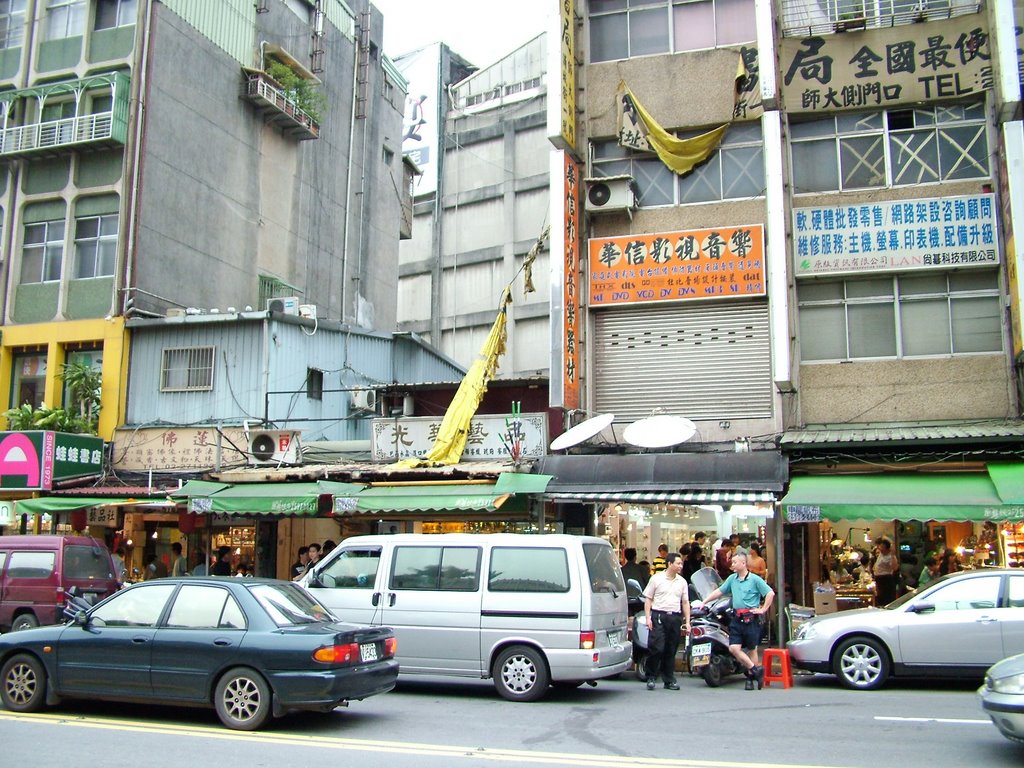
Images of Taipei: Vicinity of Bade Road (八德路) and the seven-year-old Civic Boulevard (市民大道), which now looms over the old apartment buildings, shops, and street life of central Taipei:


Some other photos from the area. It's amazing to me, even after living in Taipei for six years, the contrasts of the city. On one street there can be so much happening, like indoor markets for jade (the first photo) and just a block away, there's a quiet side street with a local temple, and not a soul in sight:


Earlier Taipei photos:

Sunday, April 23, 2006

Taipei Signs

A sampling of street signs, spotted on Chenggong Road, Neihu district, Taipei:


The last one, which is hard to make out, says in English, "Wow, Frog Eggs!", alongside a drawing of a frog. The Chinese menu lists sweet drinks made with tapioca balls, which do kind of look like frog eggs.

Friday, April 21, 2006

碧山巖: More photos

Went up to Bishan Temple (碧山巖) again, to explore the hiking paths and take more pictures:


Pictures from yesterday are here.

Thursday, April 20, 2006

Bishan Temple (碧山巖) Photos

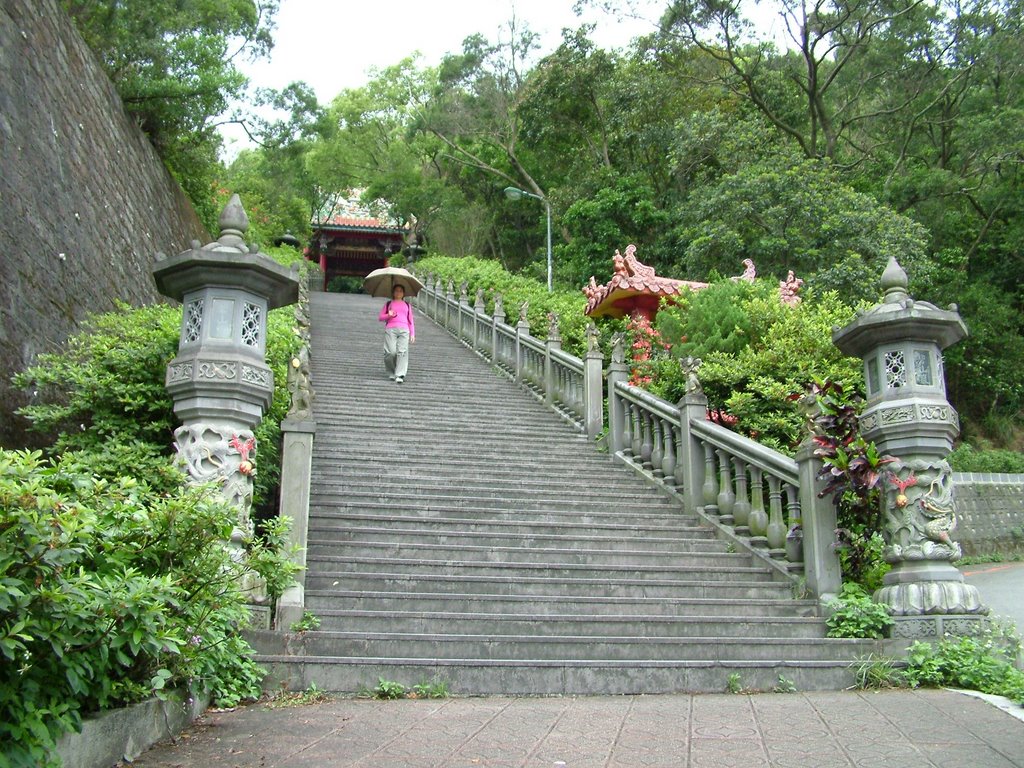
Images from Bishan Temple (碧山巖), Neihu district, Taipei:

Stairway to Bishan Temple


View from Bishan temple, facing south-southeast

Wednesday, April 19, 2006

Chinese media: Apple Daily makes a splash in Taiwan

Taiwan is a very well-known media hotspot in Asia. I remember 10 years ago seeing a stat that found its population to be the most voracious readers of newspapers in the world. Even with the advent of the Internet, newspapers are still very popular. On a recent connecting flight from the U.S. to Japan, very few of the Japanese passengers read Japanese newspapers during the 13-hour flight even though they were readily available as we got on. Contrast that with the two-hour flight from Osaka to Taipei CKS -- it seemed every third seat was occupied by a Chinese newspaper reader. Many of them were younger people in their 20s, whom I assume are Internet users when back on earth.

Staying with relatives, I observed some changes in people's media consumption habits since I lived in Taipei in the 1990s. One was my brother-in-law's switch from one of the old standbys of the Taiwan newspaper scene -- the China Times (中國時報) and United Daily News (聯合報) -- to the Apple Daily (蘋果日報). The Apple Daily made a huge splash when it debuted in Hong Kong in the late 1990s, and now that I have had a chance to look at the Taiwan version, I can see why it appeals to people like my brother-in-law.

It's not just the "lurid" elements which observers often use to describe the paper. That's certainly part of the appeal -- the back cover of the front section of the April 19, 2006 edition has a motley collection of accident and suicide photos with blurbs explaining the background of each death.

But there's a lot more to the Apple Daily than sensationalism. Many articles include accompanying charts, timelines, infographics that calculate cost (if money is involved), and artists renditions of crime scenes. There's also a huge tie-in to the social aspect of news: short blurbs of man-on-the-street reactions to news stories featuring photographs and short bios of the people being interviewed. This gives readers social cues to how they should be reacting, even if the story might not impact them directly.

These packages aren't just put together for the biggest story; it seems that about five or six stories in the front section of the Apple Daily get this type of treatment. The front-page story, for instance, screams out the main story of the day in 96-point type: "China Petroleum Corp. raises the price of gas $2 NT". No, this is not the type of news that would get 96-point headlines in most other papers (the same news is reported in a much smaller article on page A7 of the China Times), but it's part of the Apple formula, even on slow news days. Accompanying the news article about the price hike are the following elements:
  • An infographic showing recent price rises

  • A chart calculating how much it will cost for a bus ticket from Taipei to other major cities on the island, and a sidebar article on the same.

  • A chart listing the new prices of different grades of gasoline

  • A chart listing discounts available at three gas station franchises

  • Three photographs of people queuing up or filling up at gas stations

  • A man-on-the-street reaction sidebar, which includes photographs and blurbs of three people from different parts of the island reacting to the news.
The man-on-the-street reax were the most interesting to me and I am sure to lots of other readers. Two New Taiwan dollars doesn't sound like much to most people (it's about six U.S. cents) but Apple's reports were able to get some great reactions, including a Taxi driver from Taipei who pointed out that it's going to take about NT$1500 (about US$50) per month out of his pocket, and a guy from Kaohsiung who complains about CPC and notes that his salary certainly isn't rising along with the price of fuel.

The charts are also much different than what the competition prints. The China Times package on page A7, for instance, has a very old-fashioned looking, text-only chart listing the prices of fuel for each grade at each major gas station franchise. The Apple charts go much further, calculating prices for bus tickets and fill-ups for real-world trips between major cities in Taiwan, and also detailing special deals and discounts at gas stations. This is the the type of information people can use and appreciate right away, whereas the Times just gives the bare essentials, and lets people make their own calculations.

Taiwan Apple Daily's 'I'm the Prettiest' subject for April 19, 2006The Internet tie-ins for the Apple Daily are limited. The footer of every page in the front section has an email tips address, but the Web address of the paper only appears in small type below the fold on the front page. On the back cover next to the death photos there is an interesting and incongruous print feature with links to an Apple Blog. It's called "Today I'm the Prettiest" (今天我最美). The explanation says the Apple aims to seek out and print photos of the most beautiful girls the Apple's photographers happen to see "on Taiwan's biggest streets and smallest harbors." The April 19, 2006 "Today I'm the Prettiest" showcases an attractive 30-ish woman in jeans and white top who, according to the caption, happened to be walking down Zhongxiao East Road in front of the Pacific Department Store at 2:54 p.m. Snap! She's now on the back cover of the Apple. No name is given, and it's not clear how permissions work. But there she is in print, and also online, at blog.appledaily.com.tw/beauty.

One thing I like about the Apple is that it's relatively easy for me to understand. When I was at the Taipei Language Institute (中華語文研習所) I attempted to translate Chinese newspaper articles clipped from the China Times. It was bloody hard. The journalistic Chinese was complex, used lots of unfamiliar characters which required me to constantly refer to my dictionary, and had little in the way of easy-to-understand charts. My wife gets the World Daily News (世界日报) which is printed in New York, and I seldom bother attempting to read it -- Like the China Times, the headlines, articles, and even photo captions in the World Daily News are simply too hard for me. The Apple Daily, on the other hand, seems to use more colloquial Chinese in articles and accompanying package items such as infographics and man-on-the-street interviews. I was able to get the gist of several articles and features without even picking up my dictionary. Maybe foreign readers who attempt to understand the New York Times get a similar feeling when they pick of the New York Post!

When my brother-in-law gets home, I'll ask him why he switched to the Apple Daily. Is it the more interesting story packages? Or "Today I'm the Prettiest?"

Update:

My brother-in-law's reasons for buying the Apple Daily every day:
  • "It's popular"

  • "It's cheap"

  • "More information"
My wife's reasons for disliking the Apple Daily, after reading the April 19 issue:
  • "亂七八糟" (messy, confusing, chaotic)

Wednesday, March 22, 2006

Coup attempt in Taiwan?

Just spotted this in the Taipei Times:
The nation's top military leader yesterday threw his weight behind claims of a coup plot by pan-blue supporters after the bitterly disputed presidential election in 2004.

During a legislative hearing, Minister of National Defense Lee Jye (李傑) yesterday said that some military personnel had approached him and asked him to feign sickness and step aside so that they could organize a coup against President Chen Shui-bian (陳水扁).

On Monday, a second hearing began at the Taiwan High Court in a suit filed by former Chinese Nationalist Party (KMT) chairman Lien Chan (連戰) and People First Party Chairman James Soong (宋楚瑜) against Chen Shui-bian. They claim that he defamed them by asserting that there had been an attempted coup d'etat following their defeat in the election.

At Monday's hearing, Chen's lawyer showed the judge classified documents that he claimed proved the coup attempt.

He claimed that the classified documents clearly record persons, happenings, times, locations and evidence of the coup attempt.

The Liberty Times, a Chinese-language newspaper and the sister paper of the Taipei Times, yesterday reported that the classified documents said an "incumbent military adviser to the Presidential Office" and a former chief of the general staff had talked to Lee Jye and asked him to step aside on March 24, 2004.

Lee Jye, who was Chief of General Staff at the time, yesterday confirmed these reports.

"Some unidentified military personnel came to me and asked me to `play sick' so they could carry out their plans to oust the president. But, when I refused immediately, they just walked away," Lee said. "These people said that they came to me on behalf of `certain group of people.'"

However, Lee said that neither former Chinese Nationalist Party (KMT) chairman Lien Chan (連戰) nor People First Party Chairman James Soong (宋楚瑜) had approached him or sent anyone to see him on their behalf. But he said he was quite sure that the military personnel who came to him were pan-blue supporters.

"However, I couldn't say whether these military personnel came to me on behalf of Lien and Soong," Lee added.
Reminds me of a supposed coup early warning system that an ex-U.S. military man told me about, and was in operation as late as the mid 1990s -- a helmeted, armed soldier standing guard at the foot of each bridge leading into Taipei, 24 hours per day. The idea was that these soldiers would raise the alarm if they saw any unscheduled military convoys crossing into the city. They withdrew the guards in 1995 or 1996 after one of them was killed for his rifle by gangsters.

Another memory from those days -- my Mandarin teacher at the Taipei Language Institute (中華語文研習所) telling me that if a DPP (民進黨) government declared independence for Taiwan, her son, who was then doing his military service, had pledged to her that he would shoot any commanding officer who supported it. Yes, she was a mainlander, and probably a New Party (新黨) supporter at the time -- she was very suspicious of the GMD (國民黨) under Lee Deng-hui (李登輝).

Saturday, March 18, 2006

Raising Mandarin-speaking kids in America

We have two kids, a toddler and a preschooler. Before our preschooler was born, we pledged that we would make an effort to ensure she grew up being able to speak both English and Mandarin, to prepare her for a more internationally connected world, and to ensure that she can talk with her relatives in Taiwan.

For the first two and a half years of her life, she was exposed to Mandarin most of the time. At home, my wife spoke to her in Mandarin in 99% of their conversations, and myself, about 90% of the time. We read Chinese children's books to her, explained concepts to her in Mandarin, and showed her Mandarin VCDs and DVDs. She didn't attend daycare, and only had occasional contact with English-only speakers -- neighbors, my relatives, and a few kids living nearby.

The immersion strategy seemed to work. When she was 19 months and 25 days old, my wife and I sat down and recorded all of the words she was able to speak in both languages. Here's the Chinese list (translated into English):
duck, cow, horse, dog, cat, crow, bird, squirrel, mouse, pig, elephant, fish, turtle, ant, bear, monkey, rabbit, sheep (plus sounds they make)

telephone, key, toy, car, boat, book, door, baloon, shoes, socks, clothes, pants, belt, glasses, watch, hat, light, fridge, swing, candle, crayon, baby, diaper, bao bao (抱抱), kiss, bike

grapes, candy, vitamin, ice cream, noodles, rice, meat, egg, dofu, melon, banana, blueberries, cherry, strawberry, eat, bread, water, mushroom, soup, cookie, knife, fork, spoon, button, barette, air plane, music, bag, phone, fan, tea, beer, tomato, beans.

ear, nose, mouth, neck, knee, hands, tummy, belly button, hair, teeth, chin, feet, poop, pee

hot, cold, stinky

moon, sun, tree, cloud, rock, rain, stars, leaf, thunder, flower

eat, look, want/don't want, hurts, take a walk, swim, wash, cry, laugh, sleep, paint, open, close

mom, dad, grandpa, grandma, aunt (maternal & paternal), uncle (maternal)

thank you
Don't ask why she knew how to say beer (啤酒). Here's her English vocabulary list at the same point in time:
bird, bee, butterfly, boat, key, elephant, powder, teddy bear, juice, rui rui (raisins), ice cream, ye-you (yogurt), juice, bi-doom (baloon), soup, swing, slide, flower, pocket, telephone, uppie, big hug

delicious, beautiful, pretty, hot, cold, yuck-yuck, yum,

thank you, pleesh (please)
... plus the proper names of a few neighbors, as well as my parents' cats, and TV characters including Arthur, Barney, Elmo, and all four Teletubbies. Neither the Mandarin nor English lists include words that she understood, but could not say.

The Mandarin dominance began to shift very shortly after she started English-language preschool. Besides beefing up her English vocabulary, it also resulted in her asking me not to read stories to her in Chinese anymore and a newfound interest in English-language TV. By the time she turned four I'd say her Mandarin vocabulary was not as good as her English vocabulary, but her Mandarin grammar was definitely better than her English grammar, which often skipped articles and correct verb usage compared to her classmates. Sometimes Mandarin syntax will creep into her English conversation -- for instance, she'll say "open the light" instead of "turn on the light", which she gets from Mandarin (開燈).

We've tried to keep her Mandarin skills up to par as best we can. We subscribed to a satellite TV package which includes "Yoyo TV", a very good children's channel from Taiwan. We enrolled her in the local Chinese Community Center school, which meets every weekend, but she complains that "there aren't any toys there" like the English-language preschool. She still speaks Mandarin about 50% of the time with my wife, but never with me -- if I ask her a question in Chinese she'll answer in English.

Today, we took heart in the fact that she spoke entirely in Mandarin with a little friend who came over whose parents are from China, but I have a feeling that these types of exchanges will fade as both get older and enter the language and social atmospheres of the local public school system. We've thought about Chinese summer camp, or summers with the in-laws in Taiwan when she gets older, but judging by the experiences of my adult friends who grew up as ABCs or CBCs (American- and Canadian-born Chinese) it's very difficult to remain a proficient Mandarin speaker unless you spend lots of time in Taiwan or China.

As for our son, he is just learning how to talk, but we'll undoubtedly have an even tougher time with teaching him Mandarin. Why? The person he interacts with most during the day (aside from my wife) is his older sister, who speaks with him exclusively in English. This is a factor our daughter didn't have as an influence when she was his age. But we'll try pushing Mandarin with our son -- in the long run, even if he doesn't learn how to speak Mandarin properly, planting a nugget of the language in his brain will serve him well when he sees his relatives, explores his roots, develops an interest in doing work associated with Taiwan or China, or meets someone from either country.