Friday, September 29, 2006
On journalists and academics ...
From Poynter, a great blog entry by Eric Zorn of the Chicago Tribune on the differences between academics and journalists, their mutual envy, and their sometimes amusing symbiotic relationships. You'll find yourself nodding if you are a journalist, or an academic that deals with journalists.

Thursday, September 28, 2006
UC Berkeley posts free course video on Google Video
Berkeley is really pushing the envelope with providing free educational content to the public. I've written before about how UC Berkeley placed a marvellous history class online in podcast form. The latest news relates to video -- Berkeley is placing hundreds of hours of free video content on Google video. Here's the link.
There is an entire section on China-related forums and presentations, which I only briefly viewed (I am on dial-up at home). There is a series of presentations on Chinese art and politics, as well as a forum discussing climate change as it relates to Sino-US relations.
There is an entire section on China-related forums and presentations, which I only briefly viewed (I am on dial-up at home). There is a series of presentations on Chinese art and politics, as well as a forum discussing climate change as it relates to Sino-US relations.
Wednesday, September 27, 2006
Harvard on the cutting edge: A virtual Law School/Extension School class
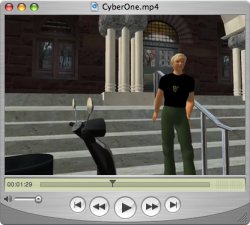 I've criticized Harvard for falling behind on online initiatives relating to video and audio, but I am proud to say that Harvard is actually a leader in an emerging, interactive online medium: Virtual worlds. The combined Harvard Law School/Harvard Extension School class CyberOne: Law in the Court of Public Opinion is really pushing the envelope with an emerging technology that has grown out of the 3D gaming and "modding" field -- creating 3D worlds that allow ordinary users to "mod" their own environments and personae.
 Check out this Crimson article, which explains how a HLS/HES class has a virtual component in Second Life:
Although at-large participants earn no accreditation for the course, they are invited to view lecture tapes and discuss class materials with professors and other students on Berkman Island, a space in Second Life that resembles Harvard Law School. The island is named after the Berkman Center for Internet & Society, of which Professor [Charles R.] Nesson is a founder and co-director.There's a lot more information about this class available online. Click here for the video promo on YouTube. Even better, go to the class website. Besides the Second Life component, the class is also embracing Wikis, blogging software, and even a software tool that's still in development -- "Scratch". There's at least one student blog by "lawgeek" which talks about the class content. (BTW: Any HES or HLS student that starts a blog and wants a link from Harvard Extended, just let me know.)
Clinical Professor of Law John G. Palfrey VI '94, executive director of the Berkman Center, applauds the project. He says, "one thing we don't do enough at Harvard or as teachers anywhere is to introduce people to new technologies, and the medium is the message to a certain point."
 This initiative is very exciting, and it ties into my research and professional interests. I am fully convinced that interactions and events within 3D worlds like Second Life will become part of the mainstream media world. We've already seen a massive virtual protest in a 3D world, as well as the first (undeclared) presidential candidate (Mark Warner) giving a press conference in Second Life. Classes, lectures, even business transactions can take place virtually. Virtual worlds are hardly mainstream, but once the tools become easier to use, the graphics improve, and people become more comfortable interacting in 3D worlds (which shouldn't be hard for members of the video game generation) this will really take off.
Sunday, September 24, 2006
Cheating rates on the rise, and why they may get worse
Two items of interest to report today, relating to cheating. The first is a survey that studied cheating at the graduate level. The results are quite alarming, according to the Reuters report:
Of course, I only read the Reuters summary, not the original paper, and there could be flaws in the methodology, sample size, etc.
The second item I'd like to point to describes an apparent move away from electronic cheating detection tools. From Techdirt:
The study of 5,300 graduate students in the United States and Canada found that 56 percent of graduate business students admitted to cheating in the past year, with many saying they cheated because they believed it was an accepted practice in business.Regardless of which group cheats more, this is a very scrary set of statistics. Not just because the numbers are so high, but also because it reflects admitted cheaters, as opposed to all cheaters.
Following business students, 54 percent of graduate engineering students admitted to cheating, as did 50 percent of physical science students, 49 percent of medical and health-care students, 45 percent of law students, 43 percent of liberal arts students and 39 percent of social science and humanities students.
Of course, I only read the Reuters summary, not the original paper, and there could be flaws in the methodology, sample size, etc.
The second item I'd like to point to describes an apparent move away from electronic cheating detection tools. From Techdirt:
... at least one university banned the use of Turnitin, one of the most popular services in this field. It seems that the student rebellion against such tools is growing, as many more students are questioning the legality of such tools, and asking their schools to stop using them. They're not just upset about the uploads, but about the assumption of guilt. While there clearly is plenty of plagiarism to go around, that doesn't mean this is the right solution to it. It's often easy to just throw technology at a problem, but it's worth recognizing that doing so always raises unexpected issues -- and those issues may not be technological on their own, but legal and cultural issues. It seems like many of the schools who jumped on the Turnitin bandwagon didn't spend much time thinking about those additional consequences, and are now facing student anger because of it.I don't agree with Techdirt's analysis or the "cultural issues" part, but the legality issue is worth considering. If such tools are banned for legal reasons at other schools, it's quite likely that cheating will become even more pevasive.
A Thai coup - echoes of 1992?
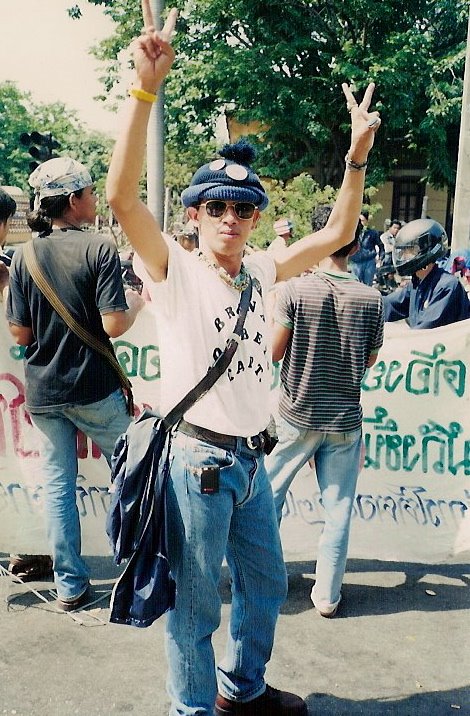 I have been following with mild interest the news coming out of Thailand about the "peaceful coup." A few articles, such as this one in the Washington Post, mention in passing the last coup, which occurred in early 1992. I was living overseas at the time, and arrived in Thailand just a few months after the 1992 coup took place. I unwittingly stayed in a cheap guesthouse a few storefronts north of the Democracy Monument in Bangkok just days before it became the center of anti-Suchinda demonstrations (Suchinda Kraprayoon was one of the coup leaders who was appointed PM in April 1992).
What followed was an almost heady experience seeing thousands of ordinary people taking to the street to peacefully protest Suchinda and his regime. Remember, this was only three years after Tiananmen, which had also started out peacefully. The Thai demonstrators basically shut down the center of Bangkok, and camped out around the monument and down the main North-South drag (Ratchadamnoen Nok). The military set up barbed wire to block off certain side streets leading to the monument, but people could come and go freely through the warren of alleys in this area. The area became filthy as city services stopped in this area, and the thousands of people just threw garbage onto the street.
Then the violence started. I am going to excerpt from the travel diary I maintained to describe what happened, from my vantage point. The pictures that accompany this post were taken with my cheap little portable camera. I have to admit some of my curiosity got me into very dangerous situations during those days, but curiosity about the world and what goes on in it is part of my character, is why I became a journalist and is why I am studying history right now at the Extension School. Note the observations related to government control of the media, and propaganda efforts to disperse the protesters.
Here are the diary entries, copied from my little paper notebook that I carried around with me at the time:
+++++++++++++++++++++++++++++
May 19, 1992: ... The shit has hit the proverbial fan, so to speak. The rally on Sunday night turned violent, when a small body of younger protesters (mostly male teens) rushed the concertina wire with motorcycles and pickup truck on the canal bridge about 500 m south of my guest house on Ratchadamnoen Ave, and attached and destroyed a police and fire station nearby, as well as police cars and fire trucks. They threw things at the rows of armed soldiers and riot cops, who regrouped and charged back, some shooting. Five ended up dying, and the gov't declared a state of emergency.
I slept through all of this, and it wasn't until Jim went to Liz and Paul's room next door at 9:00 and started saying all of this [that I realized what had happened]. The state of emergency meant that everything in Bangkok was shut for three days, including the schools where they teach English. Immediately I wanted to run out and see what had happened and what was going on, but then I told myself that I would find out soon enough. I had a shower and brushed my teeth, and then went downstairs.
Everyone except Faza and Morris was there, and the night gate was almost completely shut (it would remain that way the whole day). Someone had gotten the Bangkok Post, which gave a little information on the front [page]. The inside pages were half blank, the stories about the rally had apparently been censored. I went outside to get a copy for a souvenir, but all the stalls near Khao San Road had sold out. I also saw several hundred combat troops had lined up on both sides of Tanow Road where it intersects with Ratchadamnoen Road. Ratchadamnoen was closed because demonstrators occupied it all the way up to the monument and past it up to Phan Faa Bridge where the trouble had occured the night before.
 I went to the telephone and called up the embassy. A Thai woman explained that Americans should stay away from the area around the Democracy Monument and the Grand Palace (i.e., the area where I live) and stock up on food. I gave her my name and passport number, and when I told her where the Sweety Guest House was, she goes "Oh! What's going on now?" I told her. This [exchange] kind of surprised me. They don't have a clue. Don't the diplomats have sources in the Thai government and military?
I walked around the protestors' area. There were several thousand, most of them sitting and lying down under shaded storefronts and trees. Banners were strung up everywhere, and tons of garbage (mostly newspapers) littered the streets. On several side streets and at that bridge, police had placed concertina wire and were arrayed with shields and batons. Demonstrators sat on my side, some chatting and banging out rhythms with empty water bottles. Loudspeakers blared messages on both sides, and the police messages were greeted only with booing. I took some pictures and went to find some food.
The New World Department Store was open, but barely active. I bought a Nation downstairs, the last [copy]. It was not censored, and had a picture of four cops wailing on some guy with batons, who was curled up in a foetal position on the ground. The paper was heavily critical of the government, as opposed to a Thai government paper which had photos of injured policemen and rioters tipping over cars. I saved both ...
It was early afternoon by the time I got back, like 1:30 or so. I was tired so I lay down to rest. I had been lightly dozing for about an hour when I woke with a start. The light sound of crowds tlaking outside the hotel had been replaced by the sound of small roar. [I went out to the hall.] Jim had also heard it, and we hoisted ourselves up to the window facing Ratchadamnoen. The lines of troops and riot cops had moved about 100m closer to the monument [i.e., in our direction], and the crowds were jeering them. ... Both of us ran downstairs, grabbing our cameras. A few others dropped their cards and followed.
The troops were apparently trying to move the protestors into a smaller area. They would move about 25 or 50 meters at a time, then the protestors would sit dfown in front of them and run away the next time troops moved about a half and hour later. At first I was behind troops, but then moved toward the monument, in front of the police line. At this point there was a horrendous noise, past the monument in the direction of the bridge. It sounded like a hundred motorcycles revving their engines without any mufflers, next to my head. A kind of rippling, popping sound. Some people ran toward it, some away. I moved closer, up to the square which contains the monument. I realized that it was gunfire. It stopped momentarily, then resumed.
A [Western] reporter ran past, and I asked if they were firing live ammo. "Yes, in the air." Soon I could see the line of troops, approaching from the bridge. I turned around and stood on a flowerbed next to a building, neer some Thais. I didn;t like the feeling being between two lines of armed soldiers moving closer, kind of like the closing doors sequence in Star Wars. Soon the firing line had crossed the monument, and encircled it. Only a few were firing their weapons, but I decided to get behind the other [police] line, right in front of the Sweety [my guest house]. Most of the demonstrators had run down side streets or on the sides of the line next to the buildings like me, and were now behind the line, chanting or clapping when the monument soldiers stopped firing.
I stood around for an hour, then moved inside the Sweety. ... I went to the front entrance of the Sweety, on Ratchadamnoen Ave. The plate glass windows and doors were barred, and everyone was looking outside. The soldiers and cops to the left [south, toward the Democracy Monument] had turned around, backs to the monument and were facing the roaring crowd [in front of the hotel]. Some people on the far side of the street threw small objects, and that caused the soldiers to let off a volley. Everyone outside the window [of the guest house], several thousand people, either dived or started running. The soldiers starting marching forward [north, on a path that would take them past the guest house], helmeted riot cops about 50 meters behind them. they fled the shooting troops, but some people ran to the sides of the lines, and huddled by the buildings, raising their hands in the air. The soldiers ignored them and moved on, toward the main body [of protestors]. Some were still throwing things, and everyone was shouting. The riot cops approached our view. Some civilians, many of them women, had sat down against the bars of the Sweety. The first cops indicated with their batons for them to move on, but they cowered down even farther. A few cops came to the crowd, and started hitting them with their batons. This was about five feet away from my face, and the image of the white-helmeted, khaki-uniformed cop bringing his baton down into a group of young women and men wearing T-shirts will be etched into my mind for a long time. I snapped a picture, then moved away from the door because the same policeman gave me a look like "if those bars weren't there, you'd get some as well."
The others -- Gillie from Israel and Mark from the UK and Faza and the Big Boss [this was the guy who owned the guest house] and I don't remember the others had also watched this. Those who had cameras took pictures, and we all jerked when a soldier fired into the air about 20 feet from our position. ...
The protesters were forced down Ratchadamnoen, and stopped in the area where it intersects with several major roads, near the oval field where the busses normally depart. I walked down KSR just after dusk to cash a T-cheque, and went beyond that. There was a huge crowd, many tens of thousands of people, bigger than I had seen in the afternoon. I had no idea how big it was, people everywhere as far as I could see. I turned down Ratchadamnoen. Young men had seized a few busses, and had burned a water truck and pickup. Dozens were standing on [the vehicles], yelling at the police. There was a roar around me, and I knew there would be trouble later. I picked up a shell [casing] from the ground, and went about 20m from the front of the demonstrators. They were waving flags and shouting at that line of solders, a hundred meters beyond. The soldiers had a bank of spotlights turned on the protestors, and all I could see of them was a line of shields with the eyeslits, the soldiers crouched behind. I left, not wanting to be around when the troops started [in].
I went back to the Sweety, and spent my last 30 baht on Indian food across the road. I started watching Bullitt at 9:30, then went outside to the barricade near Tanow Road, made out of empty plastic tree pots. The rumour-mongering-Aussie-beer-drinker-who-used-to-work-in-Japan was there, talking about tanks and saying "It's cat and mouse" every five minutes. ... Gov't loudspeakers played cheezy music, then stopped. At about 10:30 there was a movement of more soldiers north, and soon after, a volley. Everyone ran to buildings and posts for cover, and civilians and reporters near the line hightailed it toward us. When the firing stopped, we could hear an enourmous roar from the angry crowd, and we saw twirling sparks which blossomed into flames -- Molotov cocktails. A few busses were pushed forward, some lit on fire. The soldiers fired more, and not just in the air. I saw tracers going horizontally. Then the troops pulled back about 50 meters, and the firing was only sporadic.
They made us leave the barricade, but I jumped up on a fence separating the sidewalk from a parking lot. A Thai man next to me spoke English, and explained a few things about the situation. He said we were not in danger, as long as the police were there and the burning mob 500 m down the road. We watched the fires reflecting off the buildings, and the occaisional ambulance. At one point a bus drove toward the line of soldiers, who ran out of the way. Some fired, and the bus lost control and crashed into a tree. The accelerator was stuck, and the engine revved for about a minute, smoking until someone turned off the engine. Camera flashes surrounded the cab, and ambulance went up. The next morning I found out that four teenagers had commandeered the bus and had been killed in this incident. The toll for the night would be 19, according to the Nation.
+++++++++++++++++++++++++++++++++++
The moral of the story (besides avoiding riots and other civil unrest abroad) is that sometimes coups may replace a government without a single shot being fired, but violence occurs weeks or months later as the political situation changes and people react to the new order. The current coup is so far peaceful. But I would hardly call the situation stable.
Thursday, September 21, 2006
Snared by Blogger captchas
I have a big problem with Blogger, the Google-owned service I use to post and host my blog. Every time I want to create a post, I have to enter "captchas", a string of scrambled letters that are meant to prevent automated programs from posting spam on the Internet. Because only humans can read captchas, they are seen as an effective way to control spam.
And I have to admit, some captchas are good captchas. You've probably encoutered them before when attempting to post a comment on an Internet forum or blog. The comment captchas make sense, because it is very easy for "spam bots" to automatically enter dozens of spam comments on a single blog post, potentially ruining the comment thread for other readers and making clean-up a nightmare for the owner of the blog.
But I have to ask the logic of forcing bloggers to deal with the captchas to post. Once I can understand. But hundreds of times? It should be obvious that a real human is running this blog, not only because I am entering the captchas every time, but because I've supplied a legitimate password, and because Harvard Extended is a legitimate blog. It would take some Google staffer two seconds to visually scan this page to see that it's real, and all the posts before it are real. It's very frustrating to deal with captchas every time I post to Harvard Extended, as they are sometimes hard to read and I fail on the first try, forcing me to read and enter a new string.
When I complained to Blogger last week, I was promised an answer but to date no one has gotten back to me. I guess I shouldn't be surprised -- it's a free service, I was sent a form email when I complained, and it's a question they probably don't want to answer.
Update: Sure enough, when I tried to post this the first time, the captcha I entered didn't match (or so they say -- maybe they didn't like my post?). So now it's a new captcha: safso. Let's hope it works.
And I have to admit, some captchas are good captchas. You've probably encoutered them before when attempting to post a comment on an Internet forum or blog. The comment captchas make sense, because it is very easy for "spam bots" to automatically enter dozens of spam comments on a single blog post, potentially ruining the comment thread for other readers and making clean-up a nightmare for the owner of the blog.
But I have to ask the logic of forcing bloggers to deal with the captchas to post. Once I can understand. But hundreds of times? It should be obvious that a real human is running this blog, not only because I am entering the captchas every time, but because I've supplied a legitimate password, and because Harvard Extended is a legitimate blog. It would take some Google staffer two seconds to visually scan this page to see that it's real, and all the posts before it are real. It's very frustrating to deal with captchas every time I post to Harvard Extended, as they are sometimes hard to read and I fail on the first try, forcing me to read and enter a new string.
When I complained to Blogger last week, I was promised an answer but to date no one has gotten back to me. I guess I shouldn't be surprised -- it's a free service, I was sent a form email when I complained, and it's a question they probably don't want to answer.
Update: Sure enough, when I tried to post this the first time, the captcha I entered didn't match (or so they say -- maybe they didn't like my post?). So now it's a new captcha: safso. Let's hope it works.
Yale to offer free course video over Internet. Why not Harvard?
Yale is going to offer video of entire classes for free over the Internet starting next year:
This is great. Previously, the only exposure most members of the public could get to these professors were through books and academic journal articles. Now people will be able to see them in a lecture setting.
Of course, MIT really set the gold standard for freely sharing academic content online with the OpenCourseWare initiative. However, the OCW project mostly shares class materials -- reading lists, handouts, lecture notes, etc. Video content is rare. This is where the Yale initiative gets interesting: Video can really convey much more than simple text materials, and also gives the audience a chance to see what kinds of questions in-class students are asking.
However, I have to question the seed money for this project. The $755,000 (donated by the William and Flora Hewlett Foundation) may sound like a lot. But as someone who has had a lot of experience producing television and Internet video content, I have to point out that in order for this initiative to scale to dozens of classes every year, much more will be required. Costs include equipment, video production and editing, creation of Web pages and containers for the video, hosting, new staff, time from existing staff, etc.
I also have to ask, why isn't Harvard taking more of a lead in sharing its academic resources with the global community? We see some piecemeal efforts involving individual schools and departments placing some class materials on the Internet for public consumption. FAS and the Harvard Extension School have actually posted Computer Science podcasts online, but video of class sessions is closed off to the public -- if you want to see anything more than a few samples, you have to pony up thousands of dollars to register for the classes, even if you aren't taking them for credit.
Yes, I understand that video production is expensive, and FAS wants to turn online video into a sustainable endeavor. But it is possible to strike a balance between serving the global public (one of former President Summers' big interests) and creating a successful, self-funding academic program. Can't Harvard at least match Yale's efforts, and provide some complete courses online for free without credit? I mean, seriously -- how big is Harvard's endowment now -- $29 billion dollars? Can't Bok or Knowles sign off on a little seed money and staff time to get something off the ground, perhaps using Extension School Distance Ed programming from previous years?
The Open Educational Resources Video Lecture Project has received $755,000 for an 18-month pilot phase. The project will create multidimensional packages—including full transcripts in several languages, syllabi, and other course materials—for seven courses and design a web interface for these materials, to be launched in the fall of 2007. If the venture proves successful, Yale hopes to significantly expand its online offerings over the next few years. The new venture joins a growing number of university-based initiatives that use the Internet to make educational materials widely available.The Yale press release adds that taping has already started this semester, for the following professors:
(See Inside Higher Ed for more details and analysis)
- Introduction to the Old Testament, with Christine Hayes, Robert F. and Patricia Ross Weis Professor of Religious Studies;
- Fundamentals of Physics, with Ramamurti Shankar, John Randolph Huffman Professor and Chair of Physics;
- Introduction to Political Philosophy, with Steven Smith, Alfred Cowles Professor of Political Science.
Those whose courses are slated for taping next spring include Charles Bailyn, Thomas E. Donnelley Professor of Astronomy; Paul Bloom, Professor of Psychology; and Langdon Hammer, Professor and Chair of English.
This is great. Previously, the only exposure most members of the public could get to these professors were through books and academic journal articles. Now people will be able to see them in a lecture setting.
Of course, MIT really set the gold standard for freely sharing academic content online with the OpenCourseWare initiative. However, the OCW project mostly shares class materials -- reading lists, handouts, lecture notes, etc. Video content is rare. This is where the Yale initiative gets interesting: Video can really convey much more than simple text materials, and also gives the audience a chance to see what kinds of questions in-class students are asking.
However, I have to question the seed money for this project. The $755,000 (donated by the William and Flora Hewlett Foundation) may sound like a lot. But as someone who has had a lot of experience producing television and Internet video content, I have to point out that in order for this initiative to scale to dozens of classes every year, much more will be required. Costs include equipment, video production and editing, creation of Web pages and containers for the video, hosting, new staff, time from existing staff, etc.
I also have to ask, why isn't Harvard taking more of a lead in sharing its academic resources with the global community? We see some piecemeal efforts involving individual schools and departments placing some class materials on the Internet for public consumption. FAS and the Harvard Extension School have actually posted Computer Science podcasts online, but video of class sessions is closed off to the public -- if you want to see anything more than a few samples, you have to pony up thousands of dollars to register for the classes, even if you aren't taking them for credit.
Yes, I understand that video production is expensive, and FAS wants to turn online video into a sustainable endeavor. But it is possible to strike a balance between serving the global public (one of former President Summers' big interests) and creating a successful, self-funding academic program. Can't Harvard at least match Yale's efforts, and provide some complete courses online for free without credit? I mean, seriously -- how big is Harvard's endowment now -- $29 billion dollars? Can't Bok or Knowles sign off on a little seed money and staff time to get something off the ground, perhaps using Extension School Distance Ed programming from previous years?
Tuesday, September 19, 2006
Presentations and an online protest in a Chinese MMORPG
Twice in recent months I've given presentations about future media trends. The first presentation was at the Siggraph Summit at Boston City Hall. The second was at Boston College, to a smaller group. It was very interesting drawing upon my print and television journalism experience, as well as my current work at Computerworld producing blogs and podcasts.
I was also able to draw upon my academic interest in Chinese mass media and Internet development in my presentations. I cited two examples. The first relates to the increasing connectedness of the Chinese population, and how they are using cheap video cameras, camera phones, and other devices to capture and distribute images that bypass the official messages put out by Xinhua/NCNA (新華社) and other state-sanctioned media outlets. These developments will have a wide-ranging effect on how people in China (and, for that matter, all over the world) understand news events:
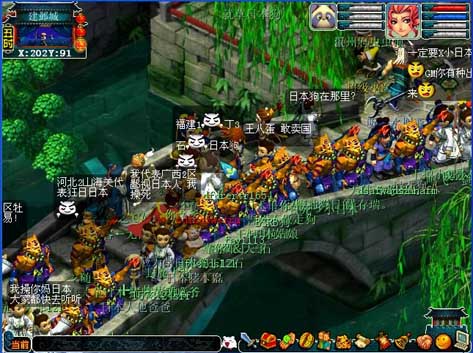
The second example was something I picked up from Roland Soong's EastSouthWestNorth blog (東南西北). Roland spotted a Beijing Evening News report about an online protest in a Chinese MMORPG which is, I believe, the first example of a mass protest over real-world issues taking place in a virtual world. The protest was sparked by a mural in the game which looked suspiciously like the "Rising Sun" flag the Japanese used in the 1930s and 1940s:
While I am on the subject of presentations and my professional experience, here are a few links to check out. The blogs are my own; the podcasts I produce and co-host with my colleagues at Computerworld.
I was also able to draw upon my academic interest in Chinese mass media and Internet development in my presentations. I cited two examples. The first relates to the increasing connectedness of the Chinese population, and how they are using cheap video cameras, camera phones, and other devices to capture and distribute images that bypass the official messages put out by Xinhua/NCNA (新華社) and other state-sanctioned media outlets. These developments will have a wide-ranging effect on how people in China (and, for that matter, all over the world) understand news events:
Think about Tiananmen Square and its most enduring image. The guy standing in front of a tank. There were two shots of this incident, both taken by pros. Imagine if something similar took place with thousands of people uploading images and video from the scene. We're already starting to see that ... the most recent example is the 2004 Tsunami, where most of the footage was from people on holiday pointing their cameras out of the windows of their hotels.(Since I gave this presentation, there has been a more relevant news event relating to China, the video from the Rui'an riots.)
 Online protest in a Chinese MMORPG
The second example was something I picked up from Roland Soong's EastSouthWestNorth blog (東南西北). Roland spotted a Beijing Evening News report about an online protest in a Chinese MMORPG which is, I believe, the first example of a mass protest over real-world issues taking place in a virtual world. The protest was sparked by a mural in the game which looked suspiciously like the "Rising Sun" flag the Japanese used in the 1930s and 1940s:
A virtual demonstration, in a Chinese online 3D game. Thousands of players from all over China converging on a virtual space, to vent about a virtual prop. These are people who are very comfortable in a 3D environment, and even bringing real-world concerns there to discuss.Incidents such as these will become more common in the years to come, and will have a very big impact on the news, newsgatherers, and audiences all over the world.
While I am on the subject of presentations and my professional experience, here are a few links to check out. The blogs are my own; the podcasts I produce and co-host with my colleagues at Computerworld.
Monday, September 18, 2006
The first proto-blog: Sei Shonagon's pillow book?
I've been reading Ivan Morris' translation of The Pillow Book of Sei Shonagon for a ten or twenty minutes on most nights before bed. The book details court life in Heian Japan (approximately 1,000 years ago) through a series of diary entries, lists, and observations written by a lady-in-waiting at the court. The Pillow Book is not arranged according to time or even topic, which makes it perfect for reading in short bursts. The style is pleasant (in large part owing to Morris' skilled translation) but it occured to me that it's wrong to compare it with a diary -- it's more like a blog, albeit one without links.
This book was originally assigned reading in Prof. Ostrowski's World History: Rise of the East course.
for a ten or twenty minutes on most nights before bed. The book details court life in Heian Japan (approximately 1,000 years ago) through a series of diary entries, lists, and observations written by a lady-in-waiting at the court. The Pillow Book is not arranged according to time or even topic, which makes it perfect for reading in short bursts. The style is pleasant (in large part owing to Morris' skilled translation) but it occured to me that it's wrong to compare it with a diary -- it's more like a blog, albeit one without links.This book was originally assigned reading in Prof. Ostrowski's World History: Rise of the East course.
Friday, September 15, 2006
Watershed event: Amateur riot video circulates in China
There's been a watershed media event in China. Amateur video of a riot that took place in Eastern China are circulating all over China and abroad, and the censors can't stop them. From Danwei:
Scenes like this are just the beginning. Expect a lot more shaky video involving official abuse or incompetence in the next few years. As I've said before, the proliferation of cheap, portable video cameras and phones with built-in cameras will cause major problems for the authorities in China, as more and more of these events -- and police abuse -- are captured and shared, and eventually uploaded to the Internet. Unless the police in China use their shiny Cisco hardware to shut down transfer of pictures and video over telecommunications networks and the Internet, there's no effective way to stop one-to-one and one-to-many transmission of clips.
As everyone in the U.S. has learned in the past 15 years or so, amateur video of riots and police abuse distributed to a wide audiece can lead to unrest rippling across the country. In China, uncensored riot clips or video of official abuse also undermine authority. Domestic TV won't show the video, but people will share them with friends or post them online, where there is no effective law enforcement. Such videos let let ordinary Chinese people -- who don't have a free press, or officials who are consistently accountable for their actions, or an independent judiciary -- see imagery of people just like them at the receiving end of police brutality. Video may be accompanied by exaggerated or incorrect context as well, potentially hurting the government's image even more.
Conclusion: The Chinese authorities are losing control of the message. Expect major political and societal changes as a result in the next five-ten years.
Earlier commentary:
Another reason China should fear the 'Net: A million people with camera phones
New Chinese Internet restrictions -- Yeah, right
Shanghai, sex, and shades of history
Freezing Point tests China's official stance on history and press freedom
Five reasons why Chinese authorities won't be able to regulate the 'Net
Futile Chinese information controls, con't
Short videos of clashes between protesters and armed police in Rui'an are circulating online. The protests stem from student dissatisfaction over the official response to an alleged suicide of their teacher, Dai Haiqing [戴海静], but have expanded into a large, occasionally destructive popular demonstration in front of Rui'an government buildings ... A popular video hosted on the Tudou server was pulled for content-related reasons, but other videos are popping up elsewhere - here are some hosted on the photobucket site; Youtube also has one. There is also a bbs linked off of the memorial site for Dai Haiqing on the online obituary website Netor.More information about this incident is carried on Global Voices Online. The ESWN blog (東南西北) also has Chinese and English context, and pictures.
Scenes like this are just the beginning. Expect a lot more shaky video involving official abuse or incompetence in the next few years. As I've said before, the proliferation of cheap, portable video cameras and phones with built-in cameras will cause major problems for the authorities in China, as more and more of these events -- and police abuse -- are captured and shared, and eventually uploaded to the Internet. Unless the police in China use their shiny Cisco hardware to shut down transfer of pictures and video over telecommunications networks and the Internet, there's no effective way to stop one-to-one and one-to-many transmission of clips.
As everyone in the U.S. has learned in the past 15 years or so, amateur video of riots and police abuse distributed to a wide audiece can lead to unrest rippling across the country. In China, uncensored riot clips or video of official abuse also undermine authority. Domestic TV won't show the video, but people will share them with friends or post them online, where there is no effective law enforcement. Such videos let let ordinary Chinese people -- who don't have a free press, or officials who are consistently accountable for their actions, or an independent judiciary -- see imagery of people just like them at the receiving end of police brutality. Video may be accompanied by exaggerated or incorrect context as well, potentially hurting the government's image even more.
Conclusion: The Chinese authorities are losing control of the message. Expect major political and societal changes as a result in the next five-ten years.
Earlier commentary:
Another reason China should fear the 'Net: A million people with camera phones
New Chinese Internet restrictions -- Yeah, right
Shanghai, sex, and shades of history
Freezing Point tests China's official stance on history and press freedom
Five reasons why Chinese authorities won't be able to regulate the 'Net
Futile Chinese information controls, con't
Thursday, September 14, 2006
UMass/Globe LexisNexis numbers: I refine the search
I was intrigued enough by the debate over the Boston Globe's coverage of UMass Boston vs. other local colleges -- and the interpretation of LexisNexis search results that might indicate bias on the Globe's part -- that I decided to conduct my own refined LexisNexis search, using some of the lessons I have learned in my own thesis research. It took less than 20 minutes, but the results clear away some of the lingering doubts concerning passing references in full-text searches in LexisNexis. I submitted the results to the Universal Hub posting "Why Doesn't The Boston Globe Care About UMass Boston," where someone questioned the original LexisNexis full-text search conducted by The Concerned Members of the UMass Boston College of Public and Community Service. I am posting the results here as well, at the bottom of this entry.
Before I describe the results, let me first say that the problem observed by commenter tblade on Universal Hub -- full-text searches turning up too many passing references to alumni, sports, etc. that naturally favor the big private universities over UMass Boston. This issue is I have been aware of since starting my own LexisNexis research on Xinhua/NCNA content relating to Vietnam. Full-text searches in 1970s Xinhua content turns up a lot of passing references to Vietnam, i.e., the ambassador from Vietnam being mentioned in passing, in the last paragraph about a banquet celebrating China's National Day. My solution in the second-stage data collection (Yoshioder sampling): Restrict searches to the headline, which gets articles that are really focused on the issue, rather than mentioning it in passing in the fourth paragraph. So, for the UMass LexisNexis searches, I restricted the results to headline references only (with one exception, described toward the bottom of this post).
There was also another potential problem with the original LexisNexis research conducted by the UMass group complaining about Boston Globe's coverage of their school: The methodology is described as follows:
My results were naturally much smaller, mainly because of the headline restriction, but I think they support the UMass group's initial observation. There is an undeniable disparity in the Boston Globe's coverage of local colleges and universities. That doesn't mean that the other UMass student (tblade) who questioned their use of LexisNexis is wrong, however. In his two comments on the Universal Hub thread, he did have some valid points about the nature of what makes news, and why the private schools will get more coverage from the Globe.
OK, without further ado, my results, which I have also submitted to Universal Hub:
Nevertheless, I'd be very interested in finding out what the Boston Globe and its two higher-ed reporters, Marcella Bombardieri and Sarah Schweitzer, have to say about the results of the LexisNexis searches, and the complaint raised by The Concerned Members of the UMass Boston College of Public and Community Service.
Before I describe the results, let me first say that the problem observed by commenter tblade on Universal Hub -- full-text searches turning up too many passing references to alumni, sports, etc. that naturally favor the big private universities over UMass Boston. This issue is I have been aware of since starting my own LexisNexis research on Xinhua/NCNA content relating to Vietnam. Full-text searches in 1970s Xinhua content turns up a lot of passing references to Vietnam, i.e., the ambassador from Vietnam being mentioned in passing, in the last paragraph about a banquet celebrating China's National Day. My solution in the second-stage data collection (Yoshioder sampling): Restrict searches to the headline, which gets articles that are really focused on the issue, rather than mentioning it in passing in the fourth paragraph. So, for the UMass LexisNexis searches, I restricted the results to headline references only (with one exception, described toward the bottom of this post).
There was also another potential problem with the original LexisNexis research conducted by the UMass group complaining about Boston Globe's coverage of their school: The methodology is described as follows:
full text Lexis-Nexis search on the names of each of the 4 private colleges for articles of all types appearing in the Boston GlobeDoes that mean the group only entered one name for each college/university in the LexisNexis search field? If the answer is yes, the searches will be flawed owing to the fact that the schools often have more than one name (i.e., formal and nickname) and headline writers try to use the short version whereever possible. In other words, if you conducted a search for "Boston University," but not BU, you'd miss almost every reference to Boston University, because headline writers for the Globe use "BU" most of the time. So, in my searches, I used multiple terms -- "Boston University" or "BU".
My results were naturally much smaller, mainly because of the headline restriction, but I think they support the UMass group's initial observation. There is an undeniable disparity in the Boston Globe's coverage of local colleges and universities. That doesn't mean that the other UMass student (tblade) who questioned their use of LexisNexis is wrong, however. In his two comments on the Universal Hub thread, he did have some valid points about the nature of what makes news, and why the private schools will get more coverage from the Globe.
OK, without further ado, my results, which I have also submitted to Universal Hub:
Good point, tblade, but I think the UMass student group is onto something here. I used LexisNexis Academic to restrict the articles to those that mentioned the schools in the headline, which screens out most of the passing references to alumni, sports, etc., and instead concentrates on legitimate coverage of college/university-related issues. Here's the ranking, for 1/1/2006 to 9/10/2006:One important note about these LexisNexis searches: I did not restrict by section or by the Globe's two higher education reporters. This resulted in an especially large number of "hits" for BC, which has strong football and basketball teams that are frequently mentioned in the Globe's sports section.
"Boston College" or "BC" in headline - 187
"Harvard" in headline - 170
"Boston University" or "BU" in headline - 62
"Northeastern University" or "NU" or "Northeastern" in headline - 47
MIT or "Massachusetts Institute of technology" in headline - 47
"University of Massachusetts at Boston" or "UMass Boston" in headline - 4
UMass in headline, and "University of Massachusetts at Boston" or "UMass Boston" in the full text, but not Dartmouth or Lowell or Amherst in full text (this allows for the short version of UMass in headline, which copy editors and editors prefer, but the article is about UMass Boston, as opposed to UMass Amherst, UMass Lowell, and UMass Dartmouth) - 11
"Framingham State" in headline - 2
Nevertheless, I'd be very interested in finding out what the Boston Globe and its two higher-ed reporters, Marcella Bombardieri and Sarah Schweitzer, have to say about the results of the LexisNexis searches, and the complaint raised by The Concerned Members of the UMass Boston College of Public and Community Service.
Boston Globe coverage of Harvard and UMass Boston - LexisNexis helps spot a trend
This is great. A group from UMass-Boston, The Concerned Members of the UMass Boston College of Public and Community Service, has written an open letter to the Boston Globe, criticizing higher education coverage that favors Harvard, Boston University and MIT while sidelining the University of Massachusetts of Boston. The writers of the letter use one of my favorite tools, LexisNexis, to make their point:
Why is there a disparity in coverage? The letter writers say:
But I agree with tblade that there's more to the story than elitism. There's the sports angle. There's the issue of more newsworthy research being done at Harvard, BU and MIT compared to Umass, Pine Manor or Framingham State, not to mention huge land deals and construction projects taking place as these giant universities expand in Allston, Cambridge, Watertown, and Chestnut Hill. These have a major impact on local politics and residents, which in turn leads to more coverage.
And let's not forget Harvard's regular parade of famous speakers that often become the focus of news. Last week it was the former Iranian president visting the Kennedy School that caused a ruckus. In a situation like this, the Globe has an obligation to report the news and the local reaction, which was overwhelmingly negative.
"... Our analysis of Globe coverage of these colleges during this calendar year, clearly demonstrates a glaring disparity when compared with UMass Boston. Between 1/1/06 and 9/10/06 according to a full text Lexis-Nexis search on the names of each of the 4 private colleges for articles of all types appearing in the Boston Globe, we determined the following number of references: Northeastern=384, MIT=558, Harvard=589, and BU was the big winner at a whopping 1010 references.However, another UMass student, "tblade", raises an interesting point in a comment posted on Universal Hub: the full text searches for these schools turns up a lot of results that only mention the schools in passing, and relating to issues that cannot involve UMass Boston owing to the relative newness of the school and lack of certain attributes, such as sports teams:
UMass Boston by contrast was referenced a mere 99 times.
If one only looks at the number of references in articles written by either of the main Globe higher education reporters Marcella Bombardieri and Sarah Schweitzer during the same period, the picture remains disturbing: Northeastern=13, BU=21, MIT=23, Harvard=31.
UMass Boston comes in last again at 6.
Clearly, the 1000 Globe mentions of BU are due in part to the large alumni base, famous alumni, sports, fascilities, etc. BU has been around 100 years longer than UMass Boston. I can only name 2 famous UMB alumni vs several famous BU alumni off the top of my head. UMB has no division 1 sports teams, and no fascilities like Nikerson Field, Aganis Arena, or the Huntington Theater to bring in oustside events, no BU medical center to bring trauma victims (UMass's medical campus is in Worcester), and no biolab.Interestingly, The Concerned Members of the UMass Boston College of Public and Community Service aren't complaining about a lack of positive coverage of UMass Boston in the Globe. They're asking why a UMass Boston scandal isn't being reported, and make a very good comparison with the Globe's regular coverage of a recent scandal taking place at my own alma mater, Boston University's College of Communication.
Why is there a disparity in coverage? The letter writers say:
Elitism.One could take their conclusion a step further -- the writers and editors at the Globe also assume that its suburban readership -- and advertisers -- don't want to hear about UMass Boston, either. The big-name, private colleges have more name recognition and a large local alumni presence not only compared to UMass, but also to the smaller private and public colleges in the area.
The UMass Boston College of Public and Community Service is simply too black, too poor, too female, too gay, too old and too disabled to be worthy of concern for the largely white middle-class writers and editors at the Boston Globe.
But I agree with tblade that there's more to the story than elitism. There's the sports angle. There's the issue of more newsworthy research being done at Harvard, BU and MIT compared to Umass, Pine Manor or Framingham State, not to mention huge land deals and construction projects taking place as these giant universities expand in Allston, Cambridge, Watertown, and Chestnut Hill. These have a major impact on local politics and residents, which in turn leads to more coverage.
And let's not forget Harvard's regular parade of famous speakers that often become the focus of news. Last week it was the former Iranian president visting the Kennedy School that caused a ruckus. In a situation like this, the Globe has an obligation to report the news and the local reaction, which was overwhelmingly negative.
The WSJ on China's new foreign media regs
More insight on the new media regs in China that benefit the NCNA/Xinhua (新華社), this time from Andrew Browne of the Wall Street Journal. Browne covers the business issues, but also added this interesting tidbit:
To learn more about NCNA/Xinhua's early efforts to compete with China Daily and foreign news agencies, see my precis of Robin Porter's Reporting the News from China.
[Xinhua President] Tian [Congming] has given signals of his global ambitions. In a recent speech carried in a Xinhua-owned magazine, he couched Xinhua's desire to compete with Reuters, Bloomberg and others in terms of protecting China's economic security and national sovereignty. Xinhua's plans, he said, had the support of China's central leadership. "Therefore, it's truly a rare opportunity. We must grab it firmly," he said. The final goal is "basic replacement of the competition."There's a bit of a logical disconnect here -- how can Xinhua compete with Reuters and Bloomberg on protecting China's economic security and national sovereignty? The Western news agencies certainly don't see this as part of their missions. If Tian really means that he wants to elevate the status of Xinhua to be on a par with Reuters et al in terms of a reliable source of news for people to turn to, good luck. I think back to what Xinhua was saying in the 1980s about competing with Western wire services and becoming a "World News Agency." It didn't happen then, and it ain't gonna happen now. The main reasons: Quality of content, and Xinhua's "mouthpiece" role -- it simply can't be trusted to consistently broadcast unbiased news about China.
To learn more about NCNA/Xinhua's early efforts to compete with China Daily and foreign news agencies, see my precis of Robin Porter's Reporting the News from China.
Monday, September 11, 2006
Futile Chinese information controls, con't
The New China News Agency (新華社) made a rare appearance in the New York Times today, not as a source of news, but as a subject of the news. China is further restricting the distribution of foreign wire service reports and photographs in China, by making NCNA (the official state news organ) the gatekeeper for news feeds from abroad:
Related posts:
New Chinese Internet restrictions -- Yeah, right
Shanghai, sex, and shades of history
Another reason China should fear the 'Net: A million people with camera phones
Freezing Point tests China's official stance on history and press freedom
Five reasons why Chinese authorities won't be able to regulate the 'Net
Under new rules that were said to take effect immediately, the state-run New China News Agency said it would become the de facto gatekeeper for foreign news reports, photographs and graphics entering China. The agency announced in its own dispatch that it would censor content that endangers “national security.The Times reporter, Joseph Kahn, ties the NCNA's expanded role into a general crackdown on news distribution in China:
President Hu Jintao has intensified a crackdown on all kinds of news media in recent months, arresting and harassing journalists, tightening regulation of Web sites and online forums, hiring tens of thousands of people to screen and block Web content deemed offensive and firing editors of state-run publications that resist official controls.-sigh- I've said it before, and I'll say it again: the state no longer has effective control of information in China. Heavy-handed regulations, prosecution of journalists, and other traditional totalitatarian mass media controls will not turn the clock back. The electronic exchange of information -- via the Web, email, SMS, etc. -- cannot be stopped, short of pulling the plug on electronic communications.
Related posts:
New Chinese Internet restrictions -- Yeah, right
Shanghai, sex, and shades of history
Another reason China should fear the 'Net: A million people with camera phones
Freezing Point tests China's official stance on history and press freedom
Five reasons why Chinese authorities won't be able to regulate the 'Net
Tuesday, September 05, 2006
Thesis update: One small step completed, but still a long way to go
I just sent off an email to my FAS thesis director, with the results of my expanded content analysis using Yoshikoder (see summary here). It's a big document set -- a brief email summary, a five-page single spaced Word document describing proposed tests and my preliminary analysis, and a 1.7 MB spreadsheet with all of my data that I've gathered since last year -- the results of NCNA frequency counts, Yoshikoder dictionary and concordance reports, charts generated from the data, etc.
It's a relief to send this to him, and I look forward to his comments. It's also nice to know that I'll have a break of at least a few days. But I know there's still a lot of work to be done. Even though I am not taking any other classes this fall, I've told my wife that I am going to be very busy at night and on the weekends over the next few months while I crank away at my thesis.
It's a relief to send this to him, and I look forward to his comments. It's also nice to know that I'll have a break of at least a few days. But I know there's still a lot of work to be done. Even though I am not taking any other classes this fall, I've told my wife that I am going to be very busy at night and on the weekends over the next few months while I crank away at my thesis.
Monday, September 04, 2006
Harvard College and the children of America's elite
A few months back I wrote about wiggle room for admissions at the Harvard Business School. This morning in the Boston Globe, I see a column by Alex Beam about affirmative action for rich people at Harvard and other Ivy League schools. Beam basically says that the children of rich alumni get to sneak around pesky admissions criteria that most other Harvard College applicants have to contend with, such as getting sky-high grades and writing stellar admissions essays. Sometimes the rich use admissions consultants to write or polish essays. Sometimes they simply use large amounts of cash, he says, drawing upon the evidence presented in Dan Golden's book The Price of Admission: How America's Ruling Class Buys Its Way into Elite Colleges -- and Who Gets Left Outside the Gates:
Golden's book is a well-reported critique of what amounts to affirmative action for rich people, who enjoy a panoply of preferences in the college admission process that outsiders could never dream of. The best-known examples are ``legacy" admissions for alumni children; scholarships reserved for upper-class sports, such as rowing; and the ultimate preference: dough. When you read how Harvard treats the children of its fat - cat Committee on University Resources -- who enjoy such perks as sit-downs with the director of admissions, personal campus tours, and access to the coveted ``Z-list" of deferred applicants -- suddenly real affirmative action for people who need it doesn't seem like such a bad idea.Beam was prompted to write this column after reading Golden's book. I haven't read the book myself, but Golden's thesis doesn't surprise me. Harvard and other schools need rich people to strengthen their endowments, get new academic programs off the ground, and build new facilities. The rich have extraordinary access to deans, university presidents, and influential alumni bodies -- far more than ordinary students or their families. If your last name is Bass, Gates, Bush, Kennedy or Ballmer you'll find it a lot easier to attend the college of your choice, compared to someone with the same high school academic and extracurricular abilities, but surnamed Jones, Lin, Martinez or O'Neill. It's unfair, but that's the way Harvard -- and many other private colleges -- work.
The most egregious example of pay-for-Crimson - play is that of Jared Kushner , now the youthful owner of The New York Observer. While Jared was applying to colleges, his dad, New Jersey billionaire developer Charles Kushner , pledged $2.5 million to Harvard, to be paid in installments. (Kushner pere pleaded guilty to tax evasion and other counts in 2004 and recently completed a prison sentence.) An official at Kushner's high school told Golden: ``There was no way anybody in . . . the school thought he would on the merits get into Harvard. His GPA did not warrant it, his SAT scores did not warrant it. We thought, for sure, there was no way this was going to happen." Kushner graduated from Harvard in 2003.
Sunday, September 03, 2006
Thesis update: Revising proposal, going granular with Yoshikoder
It's been awhile since I wrote a thesis update, but I have made a lot of progress, especially in the last two weeks, during a new data-collection phase.
As I mentioned earlier this year, I did complete my thesis proposal back in February. It was approved by the Extension School, and then in June it was tentatively accepted by a Harvard Faculty of Arts and Sciences professor who not only specializes in modern Chinese history and government policy, but also has experience conducting quantitative research.
However, before letting me start on writing the thesis, he had a few questions and suggestions regarding the proposal:
Having a tool is one thing, knowing how to use it is something else entirely. My FAS thesis director did not tell me how to use the tool beyond giving a five-minute demonstration of the interface. Nor did he tell me what methodology I should use, i.e. how I should "go granular" with the NCNA content. It was up to me to design tests of the NCNA data using Yoshikoder that would give more insights into Chinese attitudes toward Vietnam during the Deng Xiaoping era.
I've found that the best way to learn about an application or a tool, or pick up a skill, is to do something practical that lets you test out the tool or skill. That's one of the reasons I started this blog -- it helps me hone my writing skills, and forces me to stay on top of developments concerning my research interests, namely Chinese mass media and modern Chinese history. That's also how I started to use computer assisted content analysis. Coursework and reading introduced the concepts, but I was able to conduct my first computer-assited content analysis last year for my Modern Chinese Emigration class (see the results in term paper from that class, China's Emerging Overseas Chinese Policy in the Late 1970s and Implications for Ethnic Chinese Communities in Vietnam and Kampuchea).
As for learning how to use Yoshikoder, I had a practical opportunity to give the tool a spin at the 2006 Summer School, for my class Film And History: Postwar Japan and Post-Mao China. I used it to compare NCNA coverage of Chinese film directors Xie Jin (谢晋) and Zhang Yimou (张艺谋). This allowed me to get a feel for Yoshikoder's strong functionality, as well as learn a few lessons about how this powerful tool can give unexpected results -- my data was skewed in unusual directions because of the small size of the samples and the tone of the articles in the samples. (Read the results in my final paper, Evaluating Official Attitudes Toward Post-Mao Chinese Film Through a Quantitative Lens. The Yoshikoder data and analysis is described on pages 16-18).
In the past two weeks, I've used Yoshikoder in two ways to "go granular" with NCNA data relating to Vietnam. I've conducted dictionary word counts, and performed aggregated concordance analyses. This has involved several steps:
As I mentioned earlier this year, I did complete my thesis proposal back in February. It was approved by the Extension School, and then in June it was tentatively accepted by a Harvard Faculty of Arts and Sciences professor who not only specializes in modern Chinese history and government policy, but also has experience conducting quantitative research.
However, before letting me start on writing the thesis, he had a few questions and suggestions regarding the proposal:
- What was I really interested in concentrating on in my research -- Chinese policy toward Vietnam, or a quantitative methodology for studying Chinese policy? My answer: the methodology. Vietnam happened to be a convenient example. He therefore suggested that I rework my thesis proposal to stress the reasons why my methodology is useful, what advantages it holds over certain qualitative methodologies, and to use China's Vietnam policy as an example.
- How could my quantitative methodology be improved? In the February version of the proposal, I based my hypotheses on simple frequency counts of NCNA news items that mentioned Vietnam and other countries. "Go granular" with the NCNA content was the FAS professor's advice. He asked me to look at a bunch of different content analysis programs that can perform keyword in context (concordance) analysis, dictionary analysis, and other tasks beyond simple frequency counts.
One of the additional benefits of the program is that it works on Mac OS X, which I use at home. There are also Linux and Windows versions.
Yoshikoder allows you to load documents, construct and apply content analysis dictionaries, examine keywords-in-context, and perform basic content analyses, in any language.
In more detail: Yoshikoder works with text documents, whether in plain ASCII, Unicode (e.g. UTF-8), or a national encodings (e.g. Big5 Chinese.) You can construct, view, and save keywords-in-context. You can write content analysis dictionaries can be constructed using PERL-style regular expressions. Yoshikoder provides summaries of documents, either as word frequency tables or according to a content analysis dictionary. You can also compare documents according to word frequency profile or with respect to a content dictionary. Yoshikoder's native file format is XML, so dictionaries and keyword-in-context files are non-proprietary and human readable.
Having a tool is one thing, knowing how to use it is something else entirely. My FAS thesis director did not tell me how to use the tool beyond giving a five-minute demonstration of the interface. Nor did he tell me what methodology I should use, i.e. how I should "go granular" with the NCNA content. It was up to me to design tests of the NCNA data using Yoshikoder that would give more insights into Chinese attitudes toward Vietnam during the Deng Xiaoping era.
I've found that the best way to learn about an application or a tool, or pick up a skill, is to do something practical that lets you test out the tool or skill. That's one of the reasons I started this blog -- it helps me hone my writing skills, and forces me to stay on top of developments concerning my research interests, namely Chinese mass media and modern Chinese history. That's also how I started to use computer assisted content analysis. Coursework and reading introduced the concepts, but I was able to conduct my first computer-assited content analysis last year for my Modern Chinese Emigration class (see the results in term paper from that class, China's Emerging Overseas Chinese Policy in the Late 1970s and Implications for Ethnic Chinese Communities in Vietnam and Kampuchea).
As for learning how to use Yoshikoder, I had a practical opportunity to give the tool a spin at the 2006 Summer School, for my class Film And History: Postwar Japan and Post-Mao China. I used it to compare NCNA coverage of Chinese film directors Xie Jin (谢晋) and Zhang Yimou (张艺谋). This allowed me to get a feel for Yoshikoder's strong functionality, as well as learn a few lessons about how this powerful tool can give unexpected results -- my data was skewed in unusual directions because of the small size of the samples and the tone of the articles in the samples. (Read the results in my final paper, Evaluating Official Attitudes Toward Post-Mao Chinese Film Through a Quantitative Lens. The Yoshikoder data and analysis is described on pages 16-18).
In the past two weeks, I've used Yoshikoder in two ways to "go granular" with NCNA data relating to Vietnam. I've conducted dictionary word counts, and performed aggregated concordance analyses. This has involved several steps:
- Deciding how I will test the NCNA data. In other words, what indicators will help me determine which issues relating to Vietnam -- Vietnam's regional ambitions, or its relationship with the Soviet Union -- were more important to Beijing during the Deng period? I decided that taking NCNA news items that are specifically about regional issues, and comparing them with sample news items about USSR issues is the best course, but I had to isolate for Kampuchea-related items, as the war that dominated the country from the 1970s to the late 1980s would result in a higher incidence of negatively-themed articles.
- Building NCNA-specific dictionaries that Yoshikoder can use to analyze my sets of samples. I did this by selecting 21 NCNA articles with "Vietnam" (or variants) in the headline, dating from 1977-1993, concatenating them together into a single text file, using Yoshikoder to create a list of all the words used in all 21 articles, and then selecting words that could be construed as positive or negative. From the list of 200 or so negative words (and variants, used by adding a wildcard character) I eliminated words relating to military actions or armed aggression, which would show up in any items relating to the Kampuchean conflict. I then added all three NCNA dictionaries (positive, negative, and what I called "insecurity") to a file containing a positive and a negative dictionary from the General Inquirer content analysis program, each containing many of hundreds of terms used to analyze political texts.
- Creating samples of NCNA items relating to five types of news articles:
- Vietnam and USSR terms in the headline, but no other refs to Kampuchea, other regional countries or ASEAN, or the U.S. in the full text
- Vietnam and USSR and Kampuchea terms in the headline, but no other refs to other regional countries or ASEAN, or the U.S. in the full text
- Vietnam and Kampuchea and other regional countries in the headline, but no other refs to the USSR or the U.S. in the full text
- Vietnam and Kampuchea in the headline, but no other refs to the USSR or the U.S. or other regional countries in the full text
- Vietnam and other regional countries in the headline, but no other refs to the USSR or the U.S. or Kampuchea in the full text
- The dictionary-based frequency counts were performed on the samples for each type and year, and entered into Excel.
- I also performed "concordance reports" for all sample types and certain years. This involves taking a dictionary of words -- in this case, four terms relating to Vietnam (vietnamese or vietnam or nam or hanoi) -- and having Yoshikoder show me the context in which they appear for each sample, across all sample types. Two examples, with a concordance "window" of 5 terms in each direction:
... threat to the leadership in hanoi the vietnamese authorities had all ...
... china's new ambassador to viet nam DATELINE hanoi october 11 1977 ...
The idea is not to look at every sentence and apply my own eyeballs to the results, but rather let Yoshikoder do all the work, by taking these contexts of "Vietnam"-related terms, and then measuring the number of positive/negative/"insecurity" terms in each sample type over time. My guideline for picking the years: There had to be at least six news items in the sample (to improve the quality of the data, and lessen the chance of bias based on a handful of articles with a certain tone) and there had to be at least one Soviet-related as well as one regional-related sample in a given year. This restricted my concordance reports to 1978, 1979, 1980, 1985, 1986, 1987, 1988, and 1991.
Friday, September 01, 2006
Shanghai, sex, and shades of history
There's a bit of a brouhaha in Shanghai over a sex blog allegedly written by a British English teacher living in the city. The as-yet unidentified blogger was happily posting about his exploits with former students -- mixed in with often negative observations of Chinese society -- until a Chinese university professor named Zhang Jiehai (张结海) stumbled upon it, and urged a 'Net witch hunt to find this guy and get him kicked out of China. The Sex and Shanghai blog (欲望上海) has since been restricted to invited readers, but a cache shows the tone of the blog, as well as the anonymous blogger's response to Professor Zhang. The professor is casting a wide net, judging by the English translation of his call to arms, from the ESWN Blog (東南西北):
But for a university professor -- a psychology professor, at that -- to initiate a witch hunt against this man (and, by association, the women he has been with) for perceived moral transgressions and insults is outrageous. Modern Chinese history teaches us that public anger in China relating to other countries' policies toward China, and the behavior of foreigners in China, can very easily get out of control. The Boxer Rebellion in 1899-1900 and the violent demonstrations against African students living in China in the 1980s are two examples of anti-foreigner mob sentiment turning ugly.
With the current situation involving the British blogger, it is not hard to imagine his female friends -- or other women who happen to have Western boyfriends or spouses -- being ostracized or abused in other ways, ranging from having their names and pictures plastered all over the 'Net to being attacked in the street.
I wonder what it's like for Westerners living in Shanghai, especially those with local friends from the opposite sex? What's it like going out on the street with them, as Professor Zhang's angry message shoots around the city?
I've written about this topic before, as it relates to domestic victims of Chinese 'Net mobs: Internet vigilantes in China.
'Here is our action plan: In order to kick this piece of garbage out of China, the deed must be carried out by the relevant departments in Shanghai. In order for the relevant departments to take action, the media must intercede. My media friend tells me that the media needs a news "lead" in order to intercede. Therefore, the first step is to create an opinion wave on the Internet to create a happening so that the traditional media such as newspapers and television can have a 'lead' on this matter.It's interesting how Professor Zhang is manipulating the Internet and local media to achieve his goal. But it's also very unfortunate. The British blogger certainly deserves to be publically criticized for his unfair generalizations of Chinese men. It is also unfair to his female friends to describe personal details of their alleged encounters in such a public forum, especially if they can be identified by their names and other details.
Phase One (From today to early September)
During this phase, will various compatriot netizens please send this essay to all your friends via email and then ask your friends to send to all their friends? After sending this out five times, this may reach everyone who owns a computer in China. Through the forums and blogs, we will let more people (especially Chinese women) know about this affair. Since the affair occurred within the universities, we ask that this to be posted at all the university BBS's in Shanghai. Only letting all the Chinese women know about this affair can have a truly educational effect. By reducing the number of that kind of Chinese women, we can destroy this kind of ugly foreigners. Otherwise, we get rid of one piece of garbage but many more pieces of garbage will come. .... If people think that there is a foreign language teacher who fits these descriptions, or otherwise find valuable clues, please leave a comment at my blog or contact me directly via email. Netizens and compatriots, if you are a Chinese man with guts and if you respect Chinese women, please join this "Internet hunt for the immoral foreigner"! Let us act together!'
But for a university professor -- a psychology professor, at that -- to initiate a witch hunt against this man (and, by association, the women he has been with) for perceived moral transgressions and insults is outrageous. Modern Chinese history teaches us that public anger in China relating to other countries' policies toward China, and the behavior of foreigners in China, can very easily get out of control. The Boxer Rebellion in 1899-1900 and the violent demonstrations against African students living in China in the 1980s are two examples of anti-foreigner mob sentiment turning ugly.
With the current situation involving the British blogger, it is not hard to imagine his female friends -- or other women who happen to have Western boyfriends or spouses -- being ostracized or abused in other ways, ranging from having their names and pictures plastered all over the 'Net to being attacked in the street.
I wonder what it's like for Westerners living in Shanghai, especially those with local friends from the opposite sex? What's it like going out on the street with them, as Professor Zhang's angry message shoots around the city?
I've written about this topic before, as it relates to domestic victims of Chinese 'Net mobs: Internet vigilantes in China.
China's new history textbooks
Interesting development in China's public education curriculum, regarding history. Junior High and High School Textbooks are being revised. Out: Communist history, Mao, ancient dynasties. In: Cultural history, science, civilization. From the New York Times:
Zhou Chunsheng, a professor at Shanghai Normal University and one of the lead authors of the new textbook series, said his purpose was to rescue history from its traditional emphasis on leaders and wars and to make people and societies the central theme.Some things about history education are not changing, however. The article suggests that imperialist atrocities still get a lot of play in the new textbooks, while minimizing the CCP's own atrocities:
"History does not belong to emperors or generals," Mr. Zhou said in an interview. "It belongs to the people. It may take some time for others to accept this, naturally, but a similar process has long been under way in Europe and the United States."
Mr. Zhou said the new textbooks followed the ideas of the French historian Fernand Braudel. Mr. Braudel advocated including culture, religion, social customs, economics and ideology into a new "total history." That approach has been popular in many Western countries for more than half a century.
... the new ones play down historic errors or atrocities like the Great Leap Forward, the Cultural Revolution and the army crackdown on peaceful pro-democracy demonstrators in 1989.
The junior high school textbook still uses boilerplate idioms to condemn Japan's invasion of China in the 1930's and includes little about Tokyo's peaceful, democratic postwar development. It will do little to assuage Japanese concerns that Chinese imbibe hatred of Japan from a young age.
Subscribe to:
Posts (Atom)